Sunday, August 31, 2014

Union Ave. Opera - Ring Cycle Part 3

     Well, I want to begin a few reflections by stating outright that over all Union Ave Opera has achieved a great thing.  It is not easy to put on the Ring Cyle, and St. Louis has never seen a fully staged Ring before.  So hats off to them for this great achievement.  It was really pretty well done on the whole, so bravi tutti.  2ndly, i want to note that Siegfried was the 3rd in their series having produced Rheingold in 2012 and Walkure in 2013 (my reviews of those are below).  This is also the 3rd opera in their 2014 season, having performed Traviata and Streetcar Named Desire earlier in the summer.  I saw both - Traviata was good; but Streetcar was really outstanding.
    The cast for Siegfried was very strong on the whole.  The standouts were Clay Hilley as Siegfried, Jordan Shanahan as Alberich and Alexandra LoBianco as Brunnhilde.  I also really liked Marc Shapman as Mime and Cecilia Stearman as Erda.  Kate Reiman sang well as the Forest Bird, Nathan Whitson was a strong and effective Fafner whose part was drastically cut - unfortunately - and David Dillard was The Wanderer.  Of the cast I suppose David Dillard's Wanderer was the least effective as an actor, in my view, despite his beautiful and rich baritone (he's really not a bass/baritone).  He was a bit too dapper for my taste.  He was costumed in what looked like a very stylish long leather coat and he moved quickly on stage - though he was sporting a perplexing limp when he first entered and then just as quickly lost it.  I am not sure what the stage director was trying to accomplish with that.  Surely Mime would not have been fooled by the limp after all Mime had met Wotan in Rheingold - oh, oops, that scene was cut!  At any rate, I just felt he needed more gravitas in the role of the Wanderer.  After all, he is Wotan, the leader of the gods, the master of contracts and promises, the god in whom all power resides, but who is seeing his power slip away.  He is wandering in order to try to find a way to stop this from happening.  There needs to be a weariness and a sadness about him.  This Wanderer was more like he was on an cool adventure.  Especially in the scene with Siegfried there needs to be a certain amount of grave inevitability.  It was simply missing.
    Those who know me will be able to guess what my principal complaint is going to be, and it is not with the production (which I will return to in a moment).  My principal complaint is 1st and mostly with Jonathan Dove and 2nd with Scott Schnoover the conductor.  So, the full version of Siegfried has three acts and together there is over 4 hours of music.  This production put acts 1 and 2 together for the first act and then act 3 comprised act 2.  It was over in 2 hours and 20 minutes!  That is a shorter evening than Traviata!  (I timed things - The opera started at 8; Siegfried forged the sword at 8:35 and Fafner died at 9; Act 2 started around 9:30 and it was all over by 10:20).  Now, I get that the length and Wagner's long-windedness in repeating parts of the story over and over again are a problem for some audience and so I get that the point of this production is to reduce the operas to a shorter length in order to make it into a more typical evening at the opera.  But Dove's reduction of Wagner's original acts 1 and 2 was nothing short of a hack job.  As bad as the cuts were in Rheingold, these were worse.  The music suffered, the plot suffered and the opera felt like we were on a roller coaster ride.  The worst cuts of the evening for me were mostly out of Wagner's act 2: The opening scene between the Wanderer and Alberich was kept but the Wanderer waking Fafner, and the audience experiencing Fafner before the fight later on was cut (needlessly); the middle section of the great and brilliant horn solo was cut. What was left of this solo was played beautifully by 1st horn Nancy Schick, BTW.  I think they probably saved all of 30 seconds with this cut - what was the point, the word I want to use would be offensive so I'll just say that this cut was wrenching; the scene of Alberich bickering with Mime - cut.  If all of these had been restored at least in part it would have probably put the opera at the 3 hour mark.  Which would have been fine by me and it would not have felt like Dove was just ripping the score apart.  However the absolute worst cut of the evening was a the end of Wagner's act 2 / Dove's act 1: Siegfried runs off the stage following the Forest Bird and there are exactly 30 bars of music to close the act.  It is in a very fast tempo so I takes maybe a minute and half at most.  Dove cut most of it and tacked on an awkward fortissimo chord.  End of scene.  I almost left.  I was so upset by this cut.  The problem with these cuts is 1st, that they don't really save much time but they ruin the musical integrity of the score.
     The other major cut was, of course, the entirely of the Mime/Wanderer scene.  I am however sympathetic with this cut, even though I really love this 6 questions contest.  But it doesn't move the plot ahead and it just rehashes all that has gone before.  The problem though was that they cut from the set up of the contest to the last question - who will forge the sword.  And the titles included references to the Wanderer having won Mime's head, and having engaged in this contest.  But they didn't so, if you didn't know the story it would have been unclear as to what in the world this was all about.  Which leads to my 2nd complaint - since they are cutting all of the background information scenes it seems to me that either more info in the program or a pre-performance or intermission lecture might help.  The guy sitting next to me left at intermission - he could not figure out the plot.  And it is true that if you do not know the Ring it is very hard to follow, especially with all of these cuts.  So I understand why this cut was made, but the other ones were indefensible in my view.
    And if this were not bad enough, the tempi of Wagner's act 1 in particular were very, very fast.  Too fast.  This is my complaint with the conductor.  I felt like he was in a race.  The tempo he chose for what was left of the Mime/Wanderer scene was way too fast.  Also, I suspect they are working within a tight budget but the orchestra really needs more rehearsal.  There was a lot of sloppiness in the strings and not one of the woodwind chords during the Brunnhilde wakening scene was in tune - not one!  BUT - there was (finally) a tuba, and it made all the difference.  I complained after Rheingold and Walkure that the brass has no bottom.  Well finally there was a TUBA and it really improved the over all sound of the orchestra.  Dove needs to add this tuba back into the other Ring operas.
    Except for the Wanderer's dapper leather coat the costumes and the production were all good and effective.  This is not the Met, they don't have the Met budget.  But with what they had they did a great job.  They used the projections very effectively.  And I liked the projected dragon.  I thought it was kind of cool.  Better than the silly Muppet dragon they use in the current Met production.
    Finally, I want to reiterate that I believe the company performed the piece as they received it from Jonathan Dove.  My problems are with him - and are mostly the cuts which I think are way too ragged.  On the other hand, the Wagner act 3 cuts (like the Walkure cuts) were not as bad.  But the earlier cuts were horrible.  The company should be commended for their hard work and commitment to this project.  The other benefit I think is for the singers - LoBianco, Hilley and Shanahan may well some day take on these complete roles in a bigger house.  At the moment these are young and immensely talented singers.  This is a great opportunity for them to start getting familiar with these roles in a shorter version and smaller venue that I would imagine would not be as vocally taxing.  As it was their voices were almost too much for the space - they have big beautiful voices.  It is a darn shame that the cuts meant that we only ended up with about 10 minutes of Alberich and 15 minutes of Brunnhilde.
    So, tonight I think I am going to listen to a new recording I have of Siegfried conducted by Daniel Baremboim.  But I am glad I got to see Union Ave Opera's production and I look forward to the last installment next year of Gotterdammerung.

Friday, July 18, 2014

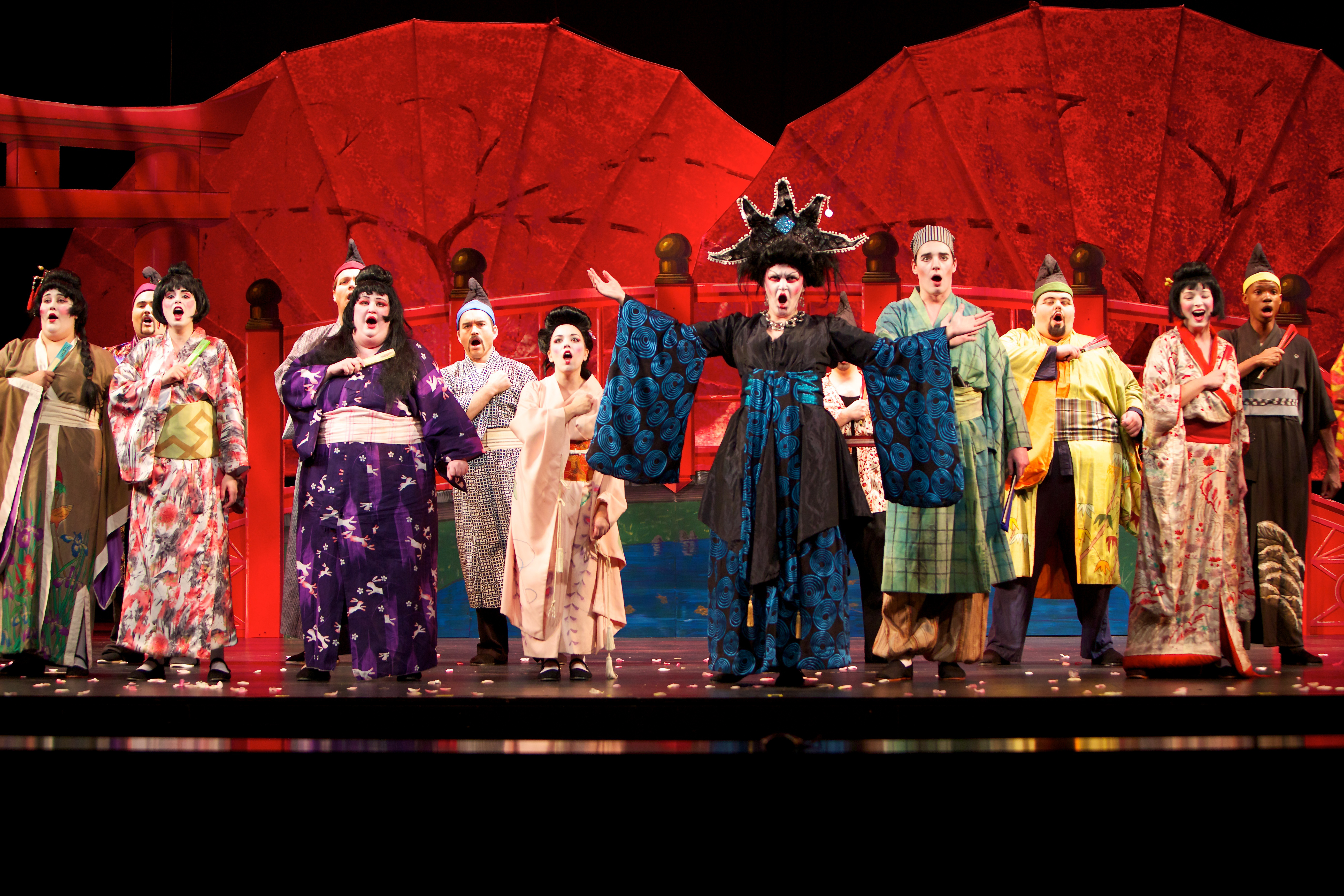
The "Mikado" Controversy in Seattle


I wanted to share some thoughts about the controversy that has erupted in Seattle over the Seattle Gilbert & Sullivan Society’s 60th anniversary production of “The Mikado.”  They had barely opened the show when a Seattle Times reporter – Sharon Pian Chan – penned an editorial entitled “Yellow-Face in Your Face.”  In this article she essentially ripped apart the company, accused them of being racist, accused them of racist casting and condemned the work itself as racist.  And once her article hit many internet trollers came out of the woodwork to join in the attacks and condemnation – much of it in harsh and hateful ways.  For its part the company seems to be in shock.  They have not responded well – IMHO.
I have not seen the production – and neither had Ms. Chan before she felt qualified on the basis of her own presumptions to trash the piece and production – so I cannot and will not speak to this specific production.  But I can speak about the piece that I know very, very well.  This then brings up a very important point. There is a difference between the piece and the production.  A much more thoughtful review of the piece by a journalist who actually took the time to see the show pointed this out (Walter Ryce): (Read the piece here)  He stated that there were some elements of the production that were over the line and advised dialing them back.  Of course that is right.  The piece itself is set in a stylized and fantasy Japan that never has really existed, but to over-Japan it with stereotypes – in make-up, costuming, bowing and high pitch nasal voices or even (God forbid) with a fake Japanese accent IS racist.  I don’t know which of these Seattle is guilty of, but this criticism is well-taken and should be carefully considered.  I have seen productions where eye make-up and lots of bowing and Ninja poses were a part of the show.  The time for this kind of thing is gone.  Directors and performers need to approach this work with more sensitivity to these kinds of things.
This reviewer also suggested that it was possible to completely remove all of the faux Japanese setting from the work.  I am a little more skeptical of this.  The productions he cited in the review drew groans from my friends on Savoynet as the general consensus was those particular productions were really badly done and consequently not really good examples.  There is an example however of a very well done production which has managed to successfully move away from the “traditional” Japanese stereotypes.  This is the English National Opera production from the 1990’s starring Monty Python’s Eric Idle as Ko-Ko.  It is worth a look.
I have to say at this point however, that for me one of the most troubling parts of this whole controversy is the fact that Ms. Chan did not bother to see the show, to read the show, to listen to the music or do any research about the history of the show before she felt compelled to write about it.  She saw a photo – one from a previous production years ago – and drew her conclusions based on this.  How in the world is this appropriate?  How can she claim to be a professional journalist when she shoots from the hip based on her own preconceptions and does no background work.  At the very least she should have gone to see the show, and she can still do this and I hope she does. 
But this seems to be a trend in our current times. The days when journalists and others actually researched their subjects before issuing judgments seems to have passed.  A similar thing happened recently at the Metropolitan Opera in New York City.  Peter Gelb, the General Director of the Met, announced that the HD broadcast of John Adam’s “The Death of Klinghoffer” would be cancelled because the Anti-Defamation League and others (probably wealthy donors) felt the piece was anti-semitic.  This is a serious charge.  What proof did they offer?  Well, none.  None of them had bothered to actually watch the opera (it is available on DVD and there are clips on Youtube) or to read the libretto (which is also available).  The ADL executive director actually admitted that he had not seen the show before drawing his conclusions.  I am sorry, but as far as I am concerned Ms. Chan and the anti-Klinghoffer crowd have no credibility if they cannot find a little time to actually experience a work before condemning it.  I find it an incredible disappointment that Mr. Gelb caved to this.  If it had been me, I would have invited the critics to meet me in my office and we would have screened the work with the librettist and composer present and engaged in a discussion.  Had Mr. Gelb done that and then decided to cancel I could have been more supportive of the decision.  The same situation is repeated here in Seattle – shoot from the hip about something you know nothing about.  Ms. Chan – you have no credibility.  Go see the show and then write about it.
(A couple articles about the Met decision worth reading:
But is the “Mikado” itself racist?  CK Chesterton once pointed out that "not one barb or criticism in the Mikado is aimed at the Japanese. All its satire fits the English." I believe that the work itself is not racist as it stands.  The piece was written and composed in the late 19th century.  That is a different world from ours.  Gilbert created a stylized setting in which he could satirize and make fun of late 19th century British culture and politics.  The chorus tells us as much in the opening chorus – “on vase, on jar, on screen, on fan.”  The names of the characters themselves are not Japanese.  They are derived from English slang.  Gilbert had no intention of mocking Japanese culture.  In fact, he went out of his way to try to respectfully include Japanese elements in the first production.  But at the same time, Gilbert was a man of his time and at the height of the British Empire he like many of his contemporaries had a strong and even arrogant sense of cultural superiority.  He was British nationalist to be sure.  His fascination with Japan was as a well-establish English man of means.  His respect of things Japanese would have probably also included a strong element of being patronizing.  It is fair to review the work with this in mind when preparing a production.  It is also instructive to note that in the early 20th century after Gilbert, Sullivan and Richard D’Oyly Carte had died and Bridget D’Oyly Carte was running the company the British government banned productions of the “Mikado” for a time out of fears of embarrassing and insulting a Japanese diplomatic delegation.  Bridget took it upon herself to invite a Japanese journalist to a private performance.  His response was that he loved the show, he laughed throughout and stated that the piece was not about Japan, it was about England.  And that is the point.
I also think we need to be very careful about superimposing 21st century sensibilities and categories upon previous times.  Our 21st century understanding of racism has come about through a painful history of 20th century events.  Racism in America is a serious and pervasive problem.  To accuse Gilbert or Dickens or Shakespeare of racism is simply unfair and uninformed.  They were men of their times and we cannot retroactively apply our own understandings upon them.  However, it would be irresponsible for us not to be sensitive to present day concerns about racism.  The “yellow-face” staging traditions are offensive to many, and not necessary to the piece; Gilbert used the “N” word in two places in Mikado, this has been rightly changed.  Despite what Gilbert’s understanding of that word was then, it is completely inappropriate now.
Ms. Chan complains about the casting.  Surely there are Asian actors who could play these parts.  Well (sigh) these comments show a complete lack of understanding of the process of casting.  First, the piece (as stated above) is actually about England and British institutions.  The characters are all British.  2nd, it is not enough to find a good actor, one needs an actor who can sing and dance in a 19th century operetta.  Undoubtedly there are many who qualify and I know that Seattle like most groups have an open audition system and any and all who are interested are welcome to apply.  Should Asian actors be given preference – cast as Nanki-Poo or Yum-Yum when they are clearly not qualified or capable or doing the roles, or not the best candidates?  If so, how would that be better?  In fact the Seattle company is multi-racial – a fact she would have noted had she attended a performance.
Should only Asian artists perform Asian roles?  Should only black artists perform black roles?  George Gershwin specified in his will that “Porgy and Bess” was only to be performed by black singers.  What about “South Pacific?”  The recent Broadway production did use Asian performers for Bloody Mary and Liat.  But should a community group not do the piece if there are no Asian performers available or interested?  I don’t think so.  Some have brought up the operas “Turandot,” or “Butterfly?”  And we could create a long, long list.  It would be a poorer world if performances of these great works were curtailed because it was not possible to fill the roles with qualified ethnic singers.  And this in not an easy proposition: take the opera “Otello” for example.  The vocal demands for the lead role are extreme.  There are few tenors who can sing this role.  Perhaps the greatest Otello of the 20th century was the great Spanish tenor Placido Domingo.  He was always made up so that his skin looked darker.  Is this racist?  I do not think so.  The piece is a piece that needs to be performed and the number of tenors in general (not to mention black tenors in particular) who can sing the role are few and far between.
Finally, I have to wonder why Ms. Chan felt this little 19th century operetta required so much time and scrutiny.  We have currently in this world a war in Iraq, a war in Gaza, a war in Ukraine and a war in Afganistan.  Currently there is an influx of children flooding our borders from Central America that has been met with a decidedly racist response by people in Texas.  We have a terrible problem with gun violence, no reasonable restrictions on guns, a prison structure that is very racist and yet Ms. Chan is writing about a 19th century operetta she doesn’t even know.  It makes no sense to me.  Racism is prevalent and real – just watch the news and the see the images of the people screaming at the children in the buses; look at the attacks on President Obama – we need to address this issue seriously.  For me the saddest part of this entire affair is that Ms. Chan could have used her position to prompt an intelligent discussion and dialog.  But instead she chose to simply write an uninformed angry piece of condemnation about which she knows little to nothing.  The people of Seattle and of our nation deserve better.

Sunday, November 3, 2013

Young Stars

One thing that has always bothered me is this phenomenon of children becoming opera singers.  Examples: Charlotte Church or especially Jackie Evancho who (supposedly) sounds like an adult.  To me, allowing them to sing like that is a bad thing - maybe even moving in the direction of child abuse.  This article explains this better than I ever could.  But the bottom line: let children be children and don't push them to be like adults.  And if they appear to have talent find a professional teacher to guide them and not push them into things that they are not yet ready for.  Sorry - a child singing Puccini or Verdi is just wrong.  Read and enjoy and learn!

Dr. Opera at the Viginia Opera!

Saturday, August 17, 2013

St. Louis' Union Ave Opera Production of "Walküre" is Triumph

Part II - Die Walküre

   I had the opportunity to experience part II of the Ring last night at Union Ave Opera of St. Louis.  They have embarked upon a 4 year project to produce all 4 Ring operas in the Graham Vick/Jonathan Dove reduction.  And right off the bat I simply want to say the performance last night was a triumph.  Union Ave Opera deserves much, much congratulations for tackling such a huge project (even in reduction the Ring is challenging) and for doing such an excellent job.  I want to also say that last night's Walküre was a big improvement over last year's Rheingold for reasons I will spell out below.  My review of Rheingold is below several posts.
    First, the cast was terrific - all of them.  James Taylor as Siegmund and Amber Smoke as Sieglinde even looked alike.  Their singing was beautiful, and their acting really drew you into them.  I felt more compassion for them last night than I had remember ever feeling before for them before.  And for the first time I felt like I wanted to go up on stage and tell Fricka to back off, and leave this poor couple of suffering twins alone.  Fricka was brilliantly sung by Elise Qugliata (returning from last year) and she was wonderful - cold and manipulative.  Everything you want in Fricka.  The Wotan of Timothy Bruno was also very effective (he was much better this year I thought).  At times I felt he displayed a little vocal unevenness, but this disappeared by the Farewell scene at the end and he really did an outstanding job of bringing the audience into his own pain and struggle.  Ultimately Wotan is not a terribly sympathetic character - he is arrogant and cruel.  But Timothy Bruno found a way to make us actually care for this god, even in the midst of his heartless cruelty to his Walsüng twins.  Nathan Whitson was a great Hunding - what a gorgeous sonorous bass voice!  I was sorry so much of his part was cut as I would like to have heard more of him (this is true with Siegmund as well).  The 3 (yes count them 3) Valkyries were very good - singing in close harmony they all nailed their hiyotohos.  Their part and scene was drastically cut so we didn't get to enjoy them as much as we might have.  
    Without taking anything from anyone else the star of this production was without a doubt Alexandra LoBianco as Brünnhilde.  I have seen the complete Ring many times - in the theater, at the Met, at LOC, on TV, Video, YouTube, etc...  I probably watch through the entire Ring at least a couple times each year.  And Alexandra can stand equal to the best Brünnhildes I have ever seen.  She was terrific in every way.  Vocally she nailed the role - not a small feat even in this reduced version and smaller venue.  Her voice was always shimmering and beautiful.  One thing I always watch for is how the Brünnhilde manages the decision to defy Wotan. This is not an easy scene dramatically and not every Brünnhilde pulls it off convincingly.  Not so here, I totally believed her.  What other choice could she have made.  Which then made Wotan's reaction to her all the more heart-wrenching and unreasonable.  It really became all about his need to be in control.  Brava Alexandra for allowing me to experience the best Brünnhilde I have experienced since Hildegard Behrens over 20 years ago!  This soprano deserves a major career.
     That being said I have to say that while Scott Schoonover did a great job pacing this opera there were problems in the pit.  In fact the only musical problems of the evening came from the pit.  Specifically (sorry - I can't ignore this) - intonation in the brass.  At times it was just terrible!  Yes I now the parts are hard, probably even more so in reduction (I have played reductions of other scores and I know that it increases the workload).  But come on, the pitch problems were at times so blatant that they detracted from the stage.  Also, the lower strings (specifically the celli) struggled in Act II.  Otherwise the orchestra was good.  The woodwinds were wonderful - I especially loved Donita Bauer on Bassoon and Jeanine York-Garesché on clarinet (but it is her bass clarinet work that really stood out).  My old friend and colleague Ann Homan played beautifully as well equally on oboe and English Horn.  The upper strings were terrific and there were times when both Principal Horn Nancy Schick and Principal Trumpet Robert Souza were really glorious.  The percussion/timpani balance (which I complained about in the Rheingold review below) was much better.  On the whole the orchestration works pretty well.  But one criticism from Rheingold continues - there needs to be more low brass.  This score needs a tuba!  Would it have ruined the concept to have added the tuba into the score.  I would like to petition Jonathan Dove to please add back in at least a tuba and maybe even a bass trombone.  (What in the world are they going to do with that incredible tuba solo at the beginning of Act II of Siegfried?).
     On the whole the cuts worked much better in Walküre than they did in Rheingold.  A couple of the cuts in Rheingold were very awkward and disconcerting (especially the cut at the beginning of the Niebelheim scene).  But not so with Walküre.  For the most part they were pretty seamless and smoother.  I really only noticed a couple of them.  For example, I was sorry that Vick/Dove felt they had to cut the death of Hunding.  So instead we have Wotan waving his spear and Hunding collapsing.  It would have added maybe 5 minutes max to have included Wotan's bitter lines - "go pray to Fricka - weh, weh, weh."  The changing of act arrangement was ok and probably necessary, but I thought ending Act II quietly was anti-climactic and disappointing.  I really didn't mind that the Ride of Valkyries was cut so drastically, it really doesn't add much to the plot and with only 3 Valkyries and I don't think the banter would have worked.  But I was surprised they chose to cut Waltraute.  She is going to make an appearance in part IV and the connection, I think is important.  Now maybe Graham/Vick will cut the Waltraute scene from Götterdämerung (I hope not) - so then it won't matter.  But just like cutting Mime from Rheingold I think it detracts from the connecting of the Ring together.
    The costumes were really nice - much better than Rheingold and I liked the projections - especially the fire at the end - very effective.  Some of the mountain projections looked a lot like LOTR scenes.  And my son pointed out to me that Nothung seemed to be an exact copy of Narsil from LOTR.  I like the connections with LOTR, even if they are not explicit (there were more in Rheingold).  
     In closing I just want to say again, this was a terrific production.  Ultimately the best part of this reduced production is to heighten the psychological depth of the story.  And I found this quite moving.  Union Ave. Opera deserves much congratulations for this. Thanks and Bravi Tutti!

Friday, May 31, 2013

Opera Theater St. Louis Presents "Pirates of Penzance"

     Well, OTSL - St. Louis' professional opera company has opened its brief season with a wonderful production of the Gilbert and Sullivan staple "Pirates of Penzance or the Slave of Duty."  I arrived at the theater kind of early so I went to the pre-performance lecture given by the rehearsal accompanist.  She did a nice job, she covered all the basics about the story of the creation of Pirates.  She left out that "Climbing Over the Rocky Mountain" was lifted from "Thespis" but I can't really criticize her for that.  Only the "inner brethern and sistern" of G&S fans really know that "Thespis" was written at all.  Much less that one great chorus was lifted by Sullivan and there are some who think that Sullivan may have lifted more than just the one chorus.  Well, I am not among those - but I digress as this is besides the point anyway. But, at some point during the talk she referred to G&S "fanatics" who "know all the shows by heart."  Guilty!  I proudly identify myself, since I am a proud member of savoynet and have been a G&S "fantatic since I was 10!
     One of the characteristics of G&S lovers (a better word than fanatic) is a deep love and respect for the text as written by Gilbert, the structure of the opera itself and the integrity of Sullivan's music and orchestrations.  I am happy to report that with one exception this production got A plusses all around on all of these issues.  The production was very traditional, not a word is cut or altered and all the songs are there.  The only disappointing exception was a cut at the very beginning as the overture - no "With Catlike Tread," no oboe cadenza and no "O Leave Me Not To Pine."  It was too bad.  I would have liked to have heard the SLSO's wonderful oboist Philip Roth play that cadenza and the following solo. I am not sure I get the point of the cut.  It's not like it takes a long time to play the whole overture. And they don't cut Mozart or Rossini overttures.  Besides, how often does one get to hear a great orchestra like the SLSO perform Sullivan?  Not very often!   Oh well.  I am happy to report, however, that they got the biggest dissapointment over with within the first 10 minutes and once the show started it was a terrific and completely traditional production.  There were lots of funny bits, some borrowed from other productions - but the choreography was fresh and fun.  
     But by far, the best thing about this production is the singing.  These singers are terrific - every single one of them - the smaller parts, like Samuel, Edith, Kate and Isabel, the chorus and all of the principals! The cast and chorus are top notch.  There is not a weak link among them.  For me I have to make special mention of Maria Zifchak as Ruth.  She is a regular compromaria at the Met in NYC and she is simply wonderful, both as a singer and actor.  Paired with Bradley Smoak as a wonderfully sonorous voiced Pirate King and heroic tenor Matthew Plenk as Frederick this trio was spectacular.  For me the highlight of the entire show was the "Paradox" scene because of these three. Deanna Breiwick was equally glorious as Mabel, and the slight improvisations to the cadenza of "Poor Wandering Ones" were clever and fun (think - flute - "Lucia di Lammermore").  Hugh Russell was acceptable as the Major General.  The tempo for the patter song was moderately fast, but the encore was a disappointment.  It seemed to me that they just returned to the regular tempo for the repetition of verse 3 for the encore.  I don't understand why they didn't double the tempo on it.  Anyway, for a G&S "Fanatic" it just wasn't quite patter enough. By the way - note to the costume designer - a Major-General has TWO stars not one!  Also the St. Louis Post-Dispatch complained about the uniform, they wanted the red dress uniform (which is traditional).  The khaki uniform, they said, seemed too informal.  Well, maybe, (how many real Major-Generals would go walking on the beach with their families wearing their dress uniforms? But this is Gilbert's Topsy-Turvy world after all!)  I do agree that the red might have made the entire entrance scene much flashier and helped him to make more of an impact on his entrance!
     Jason Eck was a good Sergeant of Police though he seemed to me to be more of a high baritone than a bass (what a beautiful upper register he has!)  But his lowest notes seemed a bit strained and difficult for him. He was funny enough in the role.  The chorus is glorious and the orchestra is - well - the orchestra is the St. Louis Symphony - what can you say - they are terrific.  The show was well paced and funny.  All around it was a great evening of Gilbert and Sullivan.  
     One last comment, in an earlier interview with the St. Louis Post-Dispatch the director, Seán Curran, is quoted as saying that he had never seen a production of Pirates before he took on this project for OTSL. And so he came at the show fresh without any baggage from other productions.  Maybe that is true - certainly his choreography is fresh and fun.  But to be quite honest there were a lot of traditional bits in this show.  And that is ok - we G&S "fanatics" like to see certain bits - probably put in my George Grossmith - continued and we miss them when they are not there.  But if he had never seen the show before how did he know about these bits? Did he consult the Martyn Green commentary? Ok, but what about the all of the bits that came right out of the Papp production - and there were many! They were funny in Papp and they were funny here.  But how can he claim to have no knowledge of Papp yet use so much of Papp in the show?  Even the big surprise at the end (which I won't give away) - which was not in Papp - but if you have seen even a few other productions you will have seen this before. I have probably seen the bit maybe 2 or 3 other times.  It was funny and fun - but not new.  So, I wasn't sure what to make of the claim that was in the paper.  Maybe the cast put all these bits in - I don't know. 
     Ultimately I suppose it is not important.  For this Pirates is a great and fun show and I wholeheartedly encourage you to plan a trip to St. Louis to see it, if for no other reason than just to hear the score sung by these glorious voices.
     A final word: I noticed in the program that over the years OTSL has done Mikado, Pinafore, Gondoliers, Cox & Box and Trial as well as Pirates.  Maybe it is time for them to think out of the box and consider doing Yeoman, Ruddigore or Iolanthe!
     Anyway - GO SEE THIS - IT IS GREAT!
Martyn Green as Major-General Stanley - D'Oyly Carte Company - See what I mean about the red dress uniform!

Thursday, April 25, 2013

"Measure for Measure" at the Goodman, Chicago

     I am trying to catch up, but I wanted to post some comments about the production of Shakespeare's "Measure for Measure" which just finished its run at the Goodman Theater in Chicago.  "Measure for Measure" is one of Shakespeare's comedies.  It is not well-known and it is not often performed.  The play itself has some difficulties (see below) and the ambiguities in the text make it hard to perform.  Like many of Shakespeare's "comedies" it certainly is not very funny.  The play is about sexual coercion, sex, law and hypocrisy.  This alone makes it probably not a play for most High School drama departments.  But still M4M is an excellent play and I think Shakespeare makes some very profound and important points about all of these issues.  The hypocrisy of the high government officials (Angelo and, yes the Duke too), who would condemn some for breaking the rules while at the same time engaging in even more depraved sexual, objectifying and cruel behavior themselves lay at the heart of the this play and is certainly a timely theme.  Those holier-than-thou types - be they religious right-wing tea-partiers or US senators or media personalities - who would condemn others for their "depravity" and "immorality" need to look to themselves.  "Look out" they scream, "allowing gay marriage will destroy traditional marriage and family," ignoring the fact that as an institution marriage has already been ripped apart by the misconduct and irresponsible behavior of morally vacant heterosexuals!  Back from 1604 then Shakespeare holds up the glass and says - see anyone familiar in the reflection, hypocrite - Angelo - Vincenzo!  This is a play for our times if there ever was one.  And on the whole this production went a long way towards lifting that mirror, but in the end it failed, unfortunately and very disappointingly. 
     First, It should go without saying that this was a fully professional production with a terrific cast.  I might quibble with some of the character interpretations here and there but the acting was top-notch by the entire company.  The production itself was updated to New York in the 60's, when New York was over-run with peep shows, prostitution and gangs. The updating worked for the most part though there were a few disconnects.  The set was terrific and easily moved and reinvented itself from scene to scene. The prison scenes were particularly stark and terrifying.
    Now I have seen other productions of this play - most notably a production at Chicago Shakespeare from a few years ago which was directed by the brilliant and incomparable Barbara Gaines. I cannot help but compare a couple things with what I remember from that production.  First and notably, in other productions the Duke, Vincenzo has come off as manipulative, weak but relatively harmless.  He is usually drawn as someone who basically wants to do the right thing.  But not in the Goodman production.  The Duke (played by James Newcomb) was THE central character in this production.  He was extremely manipulative and I got the feeling that he was somewhat malicious, actually enjoyed causing the pain that so many of the characters experience.  I liked this, and thought it was honest to the text.  This helped make this production really move forward.  It was almost as though Angelo is set up by the Duke to fail; as though the Duke anticipated his fatal flaw and knew that he would not be able to overcome it.  With the Duke larger than life, the rest of the cast is automatically a little more diminished.  Angelo moves forward under the shadow of the Duke.  This actor, Jay Whittaker, was terrific.  His Angelo was uptight, self-righteous and pedantic (as Shakespeare wrote him) but when he fell, he really fell.  The "seduction" scene was almost a rape scene and it was powerfully acted by Whittaker and the Isabella of Alejandra Escalante. I do not remember that scene as ever being staged that violently in past productions, but I was deeply affected by it.  The other character that I was struck by was the Lucio of Jeffrey Carlson.  Usually this character is played as very flamboyent. Now, I have seen Jeffrey Carlson before - he was a terrific Hal in Chicago Shakes' Henry IV parts 1 and 2 and also Marlowe's Edward II.  Carlson is an incredible actor, one of the best I have ever had the opportunity to see perform.  He can do anything the director calls on him to do.  In this case, he was, surprisingly a rather understated Lucio and as a result he was much, much more sympathetic than usual.  When the Duke goes after him at the end it really seems very malicious and cruel, and completely out of proportion.  So, Lucio insulted you a little while you were disguised - get over it!  Well done!  The Pompey of Aaron Todd Douglas was also very brilliantly played. 
    Some quibbles - First, as a pastor (albeit not Catholic, but still) I have to say that dressing the Cardinal in full liturgical garb for an office meeting with the Duke was just plain ridiculous.  Religious professionals don't wander around in full liturgical garb when they are conducting their administrative duties.  A cassock with red lining would have sufficed and been more believable.  Also, Shakespeare has the Duke disguised as a Monk.  This production had the Duke disguised as a priest.  That didn't work for me. They should have kept the religious lay professional.  One cannot just put on a collar and pretend to be a priest. I found that change nonsensical.  And another quibble, unfortunately - for me the "justice, justice, justice" speech of Isabella in the last scene of the last act is the most powerful moment in the play.  But not here.  I thought she threw that line away.  It made no impact and was over before you even knew it.  Another thing that made me uncomfortable, the actors playing Isabella and her brother Claudio (Kevin Fugaro) peppered their lines with Spanish dialog. They were the token hispanics I suppose, but it was disturbing to me that they were the only Hispanic characters in the play and it just so happens that they are also the victims.  Why not a Hispanic Provost or police officer?  Why Hispanic victims?
    My most intense criticism is about the ending.  I am not going to be giving anything away here since the play is closed.  The ending as written by Shakespeare is problematic.  There is no denying it.  In the original text Isabella "gets" to marry the Duke at the end of the play as a "reward" for being the only character in the play with any kind of morality and honesty.  But he has to ask twice and she never actually accepts the proposal.  I think for Shakespeare's original audience that might have made sense.  What could be better for a commoner in the 17th century than to have the opportunity to marry up and to become a Duchess!  But for a 21st century audience this ending sucks.  The Duke has no morality at all, he has been manipulative and downright cruel to Isabella.  He uses her differently than Angelo, but in my mind his use of her is more insidious than Angelo's.  So why would she want to marry this man.  And besides she had committed to become a nun.  In the aforementioned Chicago Shakes production the last moment of the play has the Duke claiming her in marriage and her looking expressionless out at the audience as if so communicate her shock that the sexual abuse and objectification she has already experienced are not going to end anytime soon.  It worked, and I found the ending very powerful. Now to this production.  I was wondering what in the world this director (Goodman's Artistic Director Robert Falls) would do with this, but in my wildest dreams I could not have imagined his solution to this dilemma.
    Measure for Measure is classified as a "comedy" in the Shakespeare canon.  This simply means that no one dies at the end.  It certainly doesn't mean the play is funny - because it isn't and many of Shakespeare's comedies are certainly not funny.  The other category of plays are called "tragedies" and what distinguishes them is the body count at the end.  Take "Hamlet" for example.  The only principal character left alive at the end is Horatio.  Ok, so guess what.  How was the problem ending in this play resolved in this production? This director jumped genres and turned "Measure for Measure" into a tragedy.  At the very end, Bernardine (a very minor character who I barely remember from other productions) pulls out a knife and murders Isabella!  What! Yes, Virginia, "Measure for Measure" is not a comedy after all, it is a tragedy.  But wait.  What exactly in Bernardine's motivation for such an act?  Well, let's see.... hmmmmm .... there is none.  It is totally random.  He had just been pardoned.  Ok, maybe he is a psycho and likes to kill.  Perhaps.  I'm not sure.  This Berhardine is definitely a nutcase, but as originally conceived I think he is a little morbid, dark comedic relief.  Not here, he is a psychopath.  But was this made apparent in the production?  Well, no!  From Isabella's standpoint I suppose it beats being stuck with this asshole of a Duke for the rest of your life, so maybe the director was trying to help his poor Isabella escape a fate worse than death (marrying the Duke) by murdering her. Does it sound like I am not enthusiastic about this directorial choice?  Yes.  I absolutely, positively hate it!  It simply ruins the play.  It makes me think that the director, despite his skill (which is clearly tremendous) and the many years he claims to have studied the play in the end did not really understand it and decided to take the easy way out. 
     Look, ambiguity is part of the point! Real life rarely has things tied up and resolved as neatly as they often are in plays, musicals, operas, movies and tv shows.  We all have to live with a lot of ambiguity.  By 1604 when this play was written Shakespeare himself was dealing with a lot of painful unresolved issues. Whether the poor girl is forced to marry the jerk of a Duke or whether she managed somehow to put him off, nevertheless, IMHO, murdering Isabella is the ultimate directorial cop-out!  Why struggle with the ambiguous ending, we'll just kill her off.  Poor choice.  It ruined the play for me.
     Lastly, I attended a pre-play discussion led by the dramaturg, Neena Arndt.  Of course she couldn't give away the ending.  But given the profound change that the director made to the end I really question the point of the pre-play discussion.  Maybe it should have been called an introduction to Shakespeare.  For a discussion it needed to have been scheduled for after the performance so those of us who know our Shakespeare could have vented our extreme displeasure at the horrid directorial decision which was made for the ending. But I have another complaint, during the course of this discussion I asked a question about the relation between "Measure for Measure" and "All's Well That Ends Well."  Both plays deal with sexual coercion - M4M has the victim as a woman, but in AWTED the victim is a young man. Both plays were written in and around 1604.  There has to be some connection.  But she knew nothing about it and I got the sense she didn't even know AWTEW. What a disappointment.
     Would I return to the Goodman for more Shakespeare.  Yes, of course.  This "Measure for Measure" was a provocative and brilliantly acted production.  But I would challenge the director in the future to not look for cop-outs as a way to resolve difficult and ambiguous Shakespearean endings.
    Last comment - I read the review in the Chicago Tribune.  Did that reviewer actually really attend the play?  If so, my next question is did that reviewer actually ever read that play before he attended the performance?  It does not appear so to me.

Here is a link to what is left about this production on their website: Goodman "Measure for Measure"

Friday, March 8, 2013

A Facelift...

I decided that I needed to give this blog a facelift.  It is not only about opera, but I have a great love of Shakespeare and the theater and have been a professional oboist (English Horn, Recorder) for 40 some years.  So hence the face lift.  I am currently immersed in studying Shakespeare's life and watching some DVD's of plays I haven't seen in a while (or ever) - Richard II, Lear, Merry Wives, Coriolanus.  I just received new DVD's of Much Ado and Winter's Tale and look forward to watching them.  I also today saw a trailer for Josh Whedon's new film adaptation of Much Ado - it looks interesting and I look forward to watching it.  The trailer is curious - some of the actors seemed to be kind of wooden in their delivery of the lines - but we will see.  Tonight we go to see St. Louis Winter Opera's Tosca, and last month we saw their Ballad of Baby Doe.  I am interested to see how they do this Puccini classic.  Baby Doe was good, but a little lacking in energy.  Then it is up to Danville to hear my son perform as principal bassoon with the Danville Symphony.  The program consists of two works: Mahler 1 and the Beethoven Violin Concerto.  Both of the these pieces have incredible wind parts.  I have played both on numerous occasions and I look forward to hearing the performance.

Also within the last month I saw the Met HD broadcast of Rigoletto and Parsifal.  Both were terrific.  The Rigoletto is much maligned in some circles because of the updating to Vegas in the 50's.  The Duke and his court become the Rat Pack.  I found it to be entertaining in a way that Rigoletto is usually not. I enjoyed it.  It was certainly better than the horrid Lyric Opera production from about 12 years ago which set the opera in a 19th century "Gentleman's Club."  Musically it was amazing.  The cast was terrific. I loved the duet between Rigoletto and Sparafucile at the bar.  The only disconnect for me really was having Sparafucile dump Gilda's body in the truck of his car which sported the license plate "SPARFUC."  Now what hit man in his right mind would do that.  It was cute, but kind of a silly gimmick.  The Parsifal was very beautifully sung and played.  The Met Orchestra is in my view the best orchestra at least in the USA.  And they were in great form.  Outstanding cast.  The production was good.  The pool of blood in act 2 was creepy, but I think it was supposed to be.  I love the Met and wish I could see all of their productions!

Finally I might comment on the ballet performances we saw last month.  The St. Louis Ballet Co. production of Romeo and Juliet was terrific.  They used the Prokofiev complete ballet, my first experience with it (though I played the suites on several occasions), and it was a beautiful production.  The dancing was very beautiful - especially haunting and moving was the final dance where Romeo attempts to dance with a lifeless Juliet in the tomb.  One quibble - I think they should just take a line somewhere to identify the orchestra.  I understand they used a recording - ok, fine - but what recording?  I think it sounded like an older Russian recording (based on the oboists tone).  Then we saw the Nashville Ballet in a performance of Carmina Burana. This was a joint collaboration between the U of St. Louis music department and the ballet.  The first half of the program was the St. Louis Bach group doing a cantata which was choreographed.  I didn't mind the choreography and actually enjoyed the dancers, but musically it was really poor.  Is this a true example of the quality of St. Louis Bach performances - slow tempi, no da capos, amplified singers, weak soloists and the absolute worst = using a piano for continuo!  I could barely stand to listen to it and if I could have escaped would have walked out of the first half.  I expect not to make an effort to attend any of their future performances.  The 2nd half was a lot better though.  The chorus was terrific - only one obvious difficulty and that on one of the hardest men's choruses in the piece.  The soloists were a lot better.  The bass was poor in Bach, but did a nice job with Carmina.  The student (?) orchestra was very good and the choreography was terrific!  The dancing was really outstanding, and demonstrated a really deep understanding of these medieval poems on the part of the choreographer.  Hats off to him.  My major complaint is the use of amplification!  The Touhill auditorium has nice acoustics.  The amplification was unnecessary and detrimental.  The loud chorus stuff was too loud and painful and the soft stuff lost its tenderness and intimacy.  The soprano suffered the most from the poor amplification.  She sounded harsh, though I could tell she was trying to spin her high notes the amplification ruined them! It might have worked if the engineer had taken the subtle approach of just reinforcing the voices.  But he didn't.  Personally there was no need for a sound system at all - period!  It simply marred an otherwise fine and exciting performance. 

Tuesday, February 12, 2013

"The Hollow Crown"

     Over the last three weeks PBS has been running a series called "Shakespeare Uncovered" which has been excellent and very enjoyable.  The segment on the history plays - Richard II, Henry IV, parts 1 and 2, and Henry V - really caught my eye due to the focus on a new filmed production of these 4 plays in England and broadcast under the overall title "The Hollow Crown." Of course they have not been released here in the US and one hopes that in time they will be.  However, after a little searching on the internet - guess what - all 4 plays can be seen in their entirety on YouTube (just search for "The Hollow Crown").  So over the last 2 weeks I have taken the time to watch them and thought I would share some thoughts about these films.  They were apparently filmed in anticipation of the Olympics and the Queen's 50th Anniversary and they were broadcast last summer around the time of the Olympics.  The casts include some of England's finest actors, and on the whole I found all 4 plays to be very well done and at times moving and beautifully performed.  The on-location filming was one of the best things about the films.  But they are not perfect, and so below are a couple comments about the individual films.
     Richard II stars the young British actor Ben Whishaw who has been very busy of late in "Cloud Atlas" and Helen Mirran's "Tempest."  For me "Richard II" and this performance of the title role was the high point in the entire series.  Whishaw really captures Richard's self love and Christ ideation. The supporting cast was outstanding - led by Patrick Stewart as John of Gaunt and David Suchet (of "Poirot" fame) as Edmund, the Duke of York. Unfortunately I could not find an online complete cast list so I cannot identify the actors.  But in addition to Stewart and Suchet I was also taken with the young actor who played the Duke of Aumerle and the actor who played the Earl of Northumberland. I found this to be the strongest of the 4 films, though there are a couple things worth noting.  1st, I found it very interesting that the director completely changed the ending - eliminating the character of Sir Pierce of Exton, who is the one who Shakespeare appoints to execute Richard.  He is replaced in the films by the character of the Duke of Aumerle, who is York's son and had been one of the conspirators.  By doing this the director strengthened the Christ analogy by having Aumerle play Judas.  It is too bad Shakespeare didn't think of this.  And if you think about it too long it starts to fall apart dramatically.  I think that was a misfire and a mistake.  Also, while I suppose that it is to be expected that plays where there is plenty of sword fights, battles and people having their heads cut off would include some blood and violence I found it notable that only Richard II of the 4 had explicit violence - namely the execution by beheading of Bushy and Greene done in all if gory excess. I had expected this to be the norm and was ready for another beheading in Henry IV part 2 (the Archbishop of York and his compatriots) but no.  Bushy and Greene were it - so in retrospect it seems gratuitous.  But there are small details.  On the whole Richard II is a triumph and one of the best Shakespeare films available.
    Next we come to Henry IV - parts 1 & 2.  Led by the stunning performance of Jeremy Irons as King Henry IV and backed by an excellent cast including Tom Hiddleston as Hal and Simon Russell Beale as Falstaff.  Also, Michelle Dockery, of "Downton Abbey" fame, plays Kate Percy, and the actor who plays Hotspur (I could not find his name on IMBD or the BBC sites!) are also quite extraordinary.  I especially liked how this Hotspur was completely focused on war and violence even to the point of disregarding his very beautiful wife (who at one point undresses in front of the messenger who gawks at her, even though her husband doesn't seem to notice at all!)  This has always been the way I read the play, but most performances I have seen have Hotspur melting eventually to his wife's charms - but not this Hotspur - he seems immune to the charms of his wife's beauty and her intense and devoted love! I also loved the performance of Henry Faber as the "good son" John of Lancaster, Hal's younger brother, who orchestrates with Westmorland the trickery that leads to the capture and execution of the rebellion led by the Archbishop of York.  Faber is fresh faced, innocent, charming, disarming, cold-hearted and merciless in that scene!  He is magnificent!  All of the scenes with Jeremy Irons sparkle, especially his confrontations with Hal. Iron's performance is one of the great film performances of any Shakespeare role.  I liked the Eastcheap crowd led by Falstaff.  This Falstaff was a little more smarmy than others I have seen who tended to be more jolly.  But Julie Walters as Mistress Quickly is also outstanding.  I have to say, that in contrast to the theater where my experience is that these scenes can steal the show, for me in the film version they seemed claustrophobic and I was always glad to return to Court or the battlefield.  I should give a shout out to the actor who plays Justice Shallow.  This was a sensitive and moving portrayal of a character who is usually just a joke or the butt of a joke.  I also should say that found it a little disconcerting that the few characters who were in both Richard II and Henry IV were played by different actors.  I would have preferred the same actors to play their roles in the whole series, except when age prevents it.  The exception would be Bollingbrook to King Henry IV - they are drastically different characters.  But I cannot for the life of me understand why they would have replaced the terrific Northumberland from Richard II.  There are some small cuts which are annoying - we never see John of Lancaster saving his father during the battle of Shrewsbury and we do not see why Falstaff is laying as if dead on the ground (he was attacked by Douglas in the play - but not in the film).  Minor cuts true, but kind of needless in my view.
     When we come to Henry V then the cuts take center stage as the number #1 weakness of this film.  The character of Captain Gower is eliminated and all of the banter between him and Fluellen is cut. But the worst cut is the removal of the conspiracy scene.  Olivier cut this scene from the film back when he filmed Henry V during World War II, and then it was a conscious choice for wartime and political reasons.  I am not sure if there were such reasons this time around, but for me it ruins the narrative and turns it into a jingoistic ride to the glorious victory at Agincourt.  I cannot imagine any good reason to cut this scene.  It doesn't take that long and it deepens the narrative.  This is, in my view the single worst thing about this series. On the other hand, I thought turning the boy (Falstaff's page) into the chorus at the end was brilliant.  Even so, sorry to say the battle scene at Agincourt is not as good as the Kenneth Branagh film in my view.  There was certainly more attention paid to historical accuracy in the battle scene in the Branagh film.  They pass over the French murder of the boys at the baggage train with barely a mention, and if you want to really want to understand how it was possible for Henry to win the battle of Agincourt when the odds were so stacked against him you will have to consult another source because you won't get many hints here - except perhaps divine intervention or luck.  The Branagh film devotes enough time to the long bow archers and the field conditions that one can get a better sense of why the French lost this battle.  I enjoyed Tom Hiddleston as Henry, though I liked him better as Hal.  He is a fine actor and I would love to see him do these roles on stage.  Other complaints: I did not like that Henry had no part in the hanging of Bardolph.  The hanging was over by the time Henry finds out about it.  That weakens his character and the play.  I also did not like the delivery of the famous St. Crispen's Day speech for his small group of officers.  It somehow took the power out of the speech. As mentioned above Fluellen is a cipher in this production, and nothing really matters except Agincourt.  Even so, there are fine performances by Catherine of Valois and the Duke of Exeter.  I also enjoyed the performance of the French actor who played Montjoy. (Curious that French actors were cast in most of the French roles, excepting the King - it was rather glaring he and the Dauphin that he was the only French character without a French accent.)
    In conclusion I would say that it is definitely is worth watching and owning this series.  Richard II is the strongest, Henry V is the weakest.  Wikipedia lists this series as "The Hollow Crown, part 1."  Does this mean that we can expect a part 2?  Henry VI, parts 1, 2, 3 to Richard III perhaps?  That would be nice.  But next time, go easy on the cuts please and keep the casts stable from play to play.  It adds to the strength of the production.

Sunday, November 11, 2012

"The Mikado" - Winter Opera of St. Louis

    St. Louis is an interesting city when it comes to opera.  There is Opera Theater of St. Louis, which is the sort of international company, on a par with Santa Fe or Seattle.  The orchestra is the St. Louis Symphony, the chorus are all apprentices and the singers are international stars or the next up and coming star.  The odd thing about them is that they insist for some reason on performing everything in English - which I find ridiculous and artistically indefensible.  They perform in the summer - May/June to be exact.  Then there is Union Avenue Opera which is like a really excellent regional company.  They perform in a church and their programming is really interesting (see below for my review of their August production of "Das Rheingold!").  They perform three operas from about April/May through August.  Then that leaves  September through March with no opera.  Not to worry - Winter Opera St. Louis is ready to step into the void.  They perform three operas - in 2012 "The Mikado" in November; "The Ballad of Baby Doe" in February, and finally "Tosca" in March.  I first heard about them last summer as they took their spring Boheme on the road and produced it as part of the Southern Illinois Music Festival in the Carbondale area.  They did a good job and as I am a great Gilbert and Sullivan fan and, even more than that, I ADORE "Baby Doe" I decided to check out them during their season.  And I am glad I did.
    Their "Mikado" was excellent!  The principals were all outstanding; the chorus was amazing and the orchestra excellent.  The staging was clever and the sets and costumes were beautiful and sumptuous.  There was a weak link in my view and that was the conducting, but more about that later.  First I want to ring out my praise on the cast.  All of them were excellent, but Lindsay Anderson as Katisha was terrific!  What a wonderful, powerful voice and commanding stage presence!  I can hardy wait for her Augusta Tabor in "Baby Doe."  I also loved Isaiah Bell as Nanki-Poo, Gary Moss as Poo-Bah, Kathleen Jasinskas as Yum-Yum, Lane Johnson as Ko-Ko, John Stephens as the Mikado and Erin Haupt as Pitti-Sing.  And I have call attention to possibly THE best Pish-Tush I have ever seen (and I have seen a lot).  Edward Hanlon was amazing.  How many times have we heard this role performed by weak singers or actors - not here.  Hanlon has a wonderful, rich bass voice - but he also has range and power.  I have never heard "Out Great Mikado..." sung with such power and artistry.  His acting was also outstanding.  And there was no need to bring in someone else to perform as Go-To in the Act II madrigal "Glady Dawns."  Edward Hanlon was able to handle this line with no difficulty and the quartet was sublimely beautiful (but why have the cello double Pish-Tush?  Not Necessary!).  I want to also say that the relatively small chorus had a wonderful sound - bravo to the chorusmaster and the singers in the chorus!  And lastly, I always worry about the orchestra, but from the first note - which was in tune - the orchestra showed itself to a fine ensemble. 
    The weakest link in the production was, I am sorry to say, the conductor, I am sorry to say.  The tempi were slow, slow, slow.  In fact if felt to me as though the orchestra actually slowed down in many instances.  All of the coordination problems between the pit and the stage were due to slow tempi and a conductor who did not lead but simply reacted.  I listened carefully and it was obvious to me that none of the singers were rushing.  A great example of this dragging reactive conducting problem occurred in the first act finale when Katisha sings her beautiful "The Hour of Gladness," the orchestra was behind her throughout and it was not the singers fault!  The tempo on "I Am So Proud" was terribly slow.  What a disappointment that there was no real patter in that song at "To Sit In Solemn Silence."  I was hoping they would take an encore but instead this conductor simply slogged through one of G & S' most inspired patter ensembles at a boringly slow tempo. I could go on.  Luckily the musicians on the stage and in the pit were so outstanding that they made this show work in spite of the conducting.
   My other critique is with an issue that gets a lot of attention on savoy.net, and this is the issue of updating the dialog and song lyrics.  In general I am of the camp that prefers Gilbert's dialog and lyrics to be performed untouched and unchanged.  However, I know there are some references and jokes that just don't work anymore and I am open to tasteful alterations.  And I have to say, in general, I thought this was done pretty well.  John Steven's "A More Humane Mikado..." was a great example of updating at its best.  He made some clever changes in the first verse which were funny and replaced the out of date references, but kept Gilbert's well-known and clever last verse in tact.  Ko-Ko's "Little List Song" was a bit of a misfire.  What he did was to change the words in all of the verses.  This I think was a mistake.  The verses were progressively less funny and the timely allusions got tiresome (we are all really tired of election stuff so the Romney/Obama jokes did not even get a chuckle from the audience!)  It would have been so much better to have kept the first verse in tact, make small changes in verse two and then do a complete re-write of verse three maybe with some of the clever material from verse 1.  In the dialog - most of it was kept, but there was one major misfire.  Nanki-Poo is identified as a "2nd trombone" in the original and this line comes back almost a dozen times.  In this production "2nd trombone" was replaced with "American Idol."  It was funny maybe two times, otherwise it wasn't funny at all and the audience didn't laugh, mostly because it makes no sense.  Gilbert's original would have been funnier.  I will admit to laughing at Poo-Bah's replacing of the word "stockbroker" with "1 percent" in the line to Ko-Ko that he never grovels to anyone of the 1 percent (under the rank of stockbroker).  It was funny.  That is the kind of replacement I don't usualy like, but it worked in a way that "American Idol" simply did not (and this might have been Gary Moss' delivery which was great!).
    I would have liked to have had Yum-Yum's verse in "Were you not to Ko-Ko plighted" reinstated.  This is not a criticism.  I just happen to like it and wish it was performed more often.  I did miss "See How the Fates their Gifts Alot" which was cut (except for about 8 bars which the orchestra played as moving music.)  I realize it is not Sullivan or Gilbert's most inspired song, but it does have its own charm and would like to have heard it performed if for no other reason than to give this wonderful Mikado more to sing.
    Lastly, a couple of my favorite moments - the girl running across the stage throwing (and I mean throwing) rose petals right before "Defer to the Lord High Executioner."  Ko-Ko and Katisha's business which build up to the line "Shrink not from me..." was hilarious.  The newspapers in "A Wandering Minstrel" which was beautifully sung (this bit reminded me of Gilbert's "Trial By Jury" bit with the jurors reading newspapers while the defendant sings).  Yum-Yum's "The Sun Whose Rays" was glorious.  Poo-Bah's "primordial protoplasmal globual;" the conga line in "So Please You Sir..." "Our Great Mikado, Virtuous Man," Katisha's entrance!  "The Criminal Cried!"  And the Mikado's song were all very funny. 
    So, in closing - if you live in the St. Louis area, put it on your calendars to come to "Baby Doe," and "Tosca."  This is an excellent company and they deserve your support.  Bravo on a show well done.

Here are a couple links - picture from act II finale with Katisha in the center, Yum-Yum on her right and Nanki-Poo on her left: http://www.winteroperastl.org/wp-content/uploads/2012/11/JA9C0209.jpg

Winter Opera of St. Louis

Friday, August 17, 2012

Union Ave Opera - "Das Rheingold"

     Who would have expected a small opera company to mount a production of "Rheingold" here in the mid-west?  But I just got back from the Union Ave Opera performance and I have to say hats off to them! This company, who performs three operas a year in a church in St. Louis, seems to have no qualms about tackling any project they feel drawn to.  They did "Dead Man Walking" last year and in the coming years they have the rest of the Ring Cycle scheduled!  They are using the Graham Vick/Jonathan Dove chamber arrangement - reduction of the work to be sure - an arrangement which, at least for this first installment, seems to work pretty well - but is not without it's problems.  Nevertheless, before I start nit-picking about little things I want to say that it was an outstanding performance.  Union Ave. did a great job mounting what has got to be a challenge even in the reduced form.  The singers, across the board, were great.  There was not a weak link in the cast - and they were very well balanced (unlike their earlier production of "Ballo.")  For me the standouts in the outstanding cast were - 1st and foremost - Jordan Shanahan as Alberich.  He was simply terrific.  This is a top notch singer.  But he wasn't alone - I really liked Elise Qualgliata as Fricka (I hope she will be back for "Walkure") and Todd von Felker as Fasolt.  Also, hats off to the trio of Rheinmaidens, who performed as a tight unit and had great ensemble. 
     On the whole the orchestra was good.  It is a hard score and I am sure that this reduction, like most that I have performed, is a lot more taxing even than the original.  Conductor Scott Schoonover had good control of the orchestra and maintained a good pace throughout, for the most part.  Things started to drag a bit in the opening of the 2nd scene, but the once the giants arrived the pace got back on track.  I do wonder about Jonathan Dove's orchestration.  Would it have killed him to have included a couple more horns and at least a bass trombone.  The low brass were woefully missing at times, and I am sure it was the orchestration.  And the two horns did yeoman's work with 8 reduced parts - but there were times when there was just not enough horn.  The introduction was cut (drastically) - so I am not talking about that, but, for example, when Alberich steals the gold there is a terrifying blast from the horns which was just not really effective here and I think it was because there weren't enough of them.  There were other moments in the orchestra: the low strings had intonation troubles, especially in the beginning.  And the timpani was just way too timid.  Come on - the entrance of the giants should be powerful, even terrifying - and it wasn't.  The timpani was to meek and the low brass had been cut by the orchestration so it was disappointing. On the other hand, the horns and brass played the valhalla motif beautifully.
     My biggest complaint however are the cuts.  I am not sure whether these cuts came with the reduction or were the choice of the music director.  And certainly some of them were perhaps necessary.  There is really no choice, for example, but to cut the intro if you only have 2 horns and 1 trombone - there is no way to do the 8 horn effect.  But the other cuts were excessive, I thought, and a couple of them affected the opera negatively.  The worst one is the cut of the entire opening of the Niebelheim scene, which resulted in the cutting of the entire character of Mime.  This is really unfortunate.  First, the cut was not seamless and was musically jolting. This also had the effect of ruining the development of the scene with Alberich.  Lastly, Mime is more than comic relief.  He is going to be a central character in Siegfried and Rheingold introduces him and we begin to understand who he is and what motivates him.  The other cut that I thought was really harmful musically occurred after the giants exit with Freia.  In the complete opera, Loge then watches and narrates the descent of the giants with the goddess.  Musically this has always been one of my favorite moments in the opera.  And what follows then develops better.  As it was with this cut, the giants leave with Freia and everyone immediately enters the stupor of not having had their daily apple.  In general I hated the cuts and thought they were excessive.  What are they going to do with the remaining operas in the Ring Cycle?!
     A couple other quibbles - Loge was too compassionate.  Was this his acting or the direction?  I don't know.  But he seemed to feel sorry and be compassionate for Alberich and then the giants.  I don't agree.  Loge should be aloof.  He doesn't care for anyone - like fire!  He is manipulative and selfish. In fact I don't think he really has feelings.  He champions the Rheinmaidens out of a sense of justice.  But there should be no pity for Alberich.  Also, the costumes were pretty good for everyone - except Loge and Donner.  Loge's costume was a complete misfire.  The wig didn't work and the outfit made no sense to me.  And Donner's costume just didn't seem to fit.  And what is with the oversize (papier maché?) hammer? Over kill I think. (BTW - What happened to the anvil strike at the climax of Donner's invocation?!?)  There needed to be more Niebelungs and they need to scream!  It seemed to me like the director did not know what to do with Froh and Donner a lot of the time, they just kind of wandered aimlessly around the stage.  So why did they enter at the beginning of scene 2 with Wotan and Fricka?  There is no good reason and they seemed to not know what to do with themselves.  On the other hand, I really liked the video projections - very effective.  And what a great idea for Loge to put Alberich the toad in his pocket! Also, the costumes for the giants were terrific, as were the Rheinmaidens. (Why was Freia in pink and the rest of the gods in white?)
    In closing this review I have to note that I noticed some Tolkien "Lord of the Rings" references.  Was this just my imagination or did the director purposely put these subtle suggestions into the opera?  Alberich looked like Gimli (except for the beard) and the gods (except Freia) looked elves. Wotan removed the Ring of Power from Alberich's hand by cutting off his finger (a la Frodo and Golum).  But the major allusion was this: I could not help notice that at the very end of the opera the video effect looked eerily like the eye of Sauron.  These are not criticisms.  I actually thought these were kind of cool and it is possible I am imagining them.  But they did seem to jump out at me.
     I know the Ring Cycle very well.  I have seen multiple performances - live and on video.  And I have to say that this was, on the whole, a very effective and excellent performance.  And in many ways I found it more effective and engaging than the horrid LePage production that the Met mounted (which I saw partly live and partly in HD).  And I am sure Union Ave did not have anywhere near the budget that they had at the Met.  And yet, with great singers, creativity, cleverness, and maybe a little fearlessness - and probably lots of volunteer hours - Union Opera was able to give St. Louis a wonderful Wagnerian experience.  Bravo and Thank you!  Union Ave. Opera is a treasure!

Wednesday, August 15, 2012

Misquoting Shakespeare!

Ok - so I am in a bad mood and nobody will read this post so who cares - but one of my great pet peeves are people who think they are being smart by quoting Shakespeare but they have not only the quote itself wrong but also the context completely wrong, so their cleverness is just plain ignorance.  Here are some examples:
1. The number one most misquoted line from Shakespeare that I have experience is from "12th Night." How many times have we heard folks (even politicians and preachers) in an effort to be profound come out with this: "Some are born great, some achieve greatness and some have greatness thrust upon them."  Sounds so inspirational, right!  Wrong! It is not.  The context is that the line appears in a letter that Malvolio finds which he thinks was written by the Lady Olivia (who is his employer and his secret crush), but in reality was written by the maid Maria and her cohorts who are trying to trick and humiliate poor Malvolio - which, by the way, the succeed in doing.  The line in this context is pompous nonsense which Malvolio believes but we in the audience recognize is a ploy and is simple nonsense.  This is not profundity - it is trickery and manipulation!
2. "Romeo and Juliet" is not about love.  I just saw yet another silly Facebook piece of cleverness which attempted to be profound by spouting some eternal truth about "love" using R&J as the starting point.  Sorry - please go read the play.  The play is about vengeance, and revenge and hate, and how those things will eat you up and destroy you and everything you hold dear eventually (those who attempt to shore up their political power by manipulating hate and fear should take note - yes, I'm talking to you right-wing zealots!)
3. "The play's the thing!"  Isn't this such a nice quote to lift up the importance of theater?!  Sorry, not really.  The play's the thing to use to trick and manipulate the emotions of King Claudius so that Hamlet can determine if he is guilty of murdering his father!  The "play" is simply a vehicle to clarify for Hamlet the guilt of his uncle the King!
4. I have already written about the downright stupid ban of the play "Tempest" by people who obviously do not know or understand the play. 

The fact is that Shakespeare is perhaps the greatest writer in the history of western literature whose work is a deep reflection of the human experience - but it is not surface stuff.  What makes Henry IV, parts 1 and 2 incredible is not all of the battle scenes - it is the relationships between Hal and Falstaff and, especially Hal and his father. Shakespeare still has some incredibly profound things to say to us in our society.  I just saw a brilliant production of "Timon of Athens" and then a production of "Coriolanus." Both of these plays have a lot to say to us in our society - about the power and place of wealth and the political process. But please, please, please read the plays and if you are going to impress your friends by quoting him, know the not only the text, but the context too.

I think I need to watch something - let's see what will it be?  I have a "Winter's Tale," "Henry VIII." "Merry Wives," "King Lear," and "Hamlet" videos I have not yet watched.  In my current mood perhaps "King Lear" is not the best choice!

Sunday, February 19, 2012

"The Tempest" - Banned!?!?

  I recently read an article that some group in Arizona - either the legislature or the state school board (it happened a while ago and I could find no articles which actually stated who imposed this ban) - has banned the "Tempest" by Shakespeare.  Apparently this is a part of some overall ban of some nebulous category they are calling "ethnic studies."  The whole thing seems ludicrous to me.  I completely and thoroughly reject banning books - every and any books.  As a society we need to be constantly considering ideas, we need to learn to consider and debate and reject ideas.  If those ideas are never allowed to enter public discourse then we do not learn, we do not grow and we as a society looses and are poorer as a result.  Banning books is done out of fear and ignorance - those who would advocate banning have allowed their fear of ideas and their arrogance to take over. This is a bad thing.  But back to Shakespeare.  I am trying to understand why in the world "The Tempest" of all of Shakespeare's plays would be the one chosen to be banned.
  Let's see.  It can't be sex - Miranda and Ferdinand are perhaps one of the most virtuous couples in all of Shakespeare.  In fact Prospero gives a speech mid-play which would make those who advocate abstinence proud.  And there is more sex in "Romeo and Juliet" and in "Troilus and Cressida."  How about violence?  Hmm - no one dies.  Unlike "Hamlet," Richard III," "Othello," "Lear," "Julius Caesar," and I could go on and on (not to even mention the bear eating the human scene from "Winter's Tale" or Shakespeare orgy of violence "Titus Andonicus.")  All of these plays remain unbanned.  Perhaps it is the magic.  There is the spirit Ariel, there is lots of magic.  But surely there is more magic in "Midsummer Night's Dream" (not to mention "Harry Potter" or "Lord of the Rings").  Then what else. Gary Panetta in his usual astute way suggests that the reason has to do with the character of Caliban, and Caliban's relationship with Prospero.
   Ok. Caliban is often seen as a symbol of the peoples of the places that were just beginning to be colonized in the early 17th century.  Places like Africa and North America had human populations with darker skin and different cultural traditions.  They were seen as beastly, and novelties by white Europeans.  They were also enslaved, and England at the time of Shakespeare had slavery.  It has been argued that Caliban represents these peoples and Prospero in his relationship with Caliban represents the brutal and cruel white Europeans.  Perhaps.  It is true.  Prospero does not treat Caliban well.  And Caliban hates Prospero.  But Caliban also joins up with Stephano and Triculo who are not admirable white Europeans by any account.  Next to these fools Caliban looks downright wise.  So, is is always the case in Shakespeare, it is mixed.  There is no propaganda here.  Shakespeare didn't (I think) understand Caliban himself.  And one could argue that Caliban is one of the nobler characters in the Tempest.  And in the end Prospero renounces his magic and so Caliban is set free.
   If this is the reason for the ban - I still don't understand it. Colonization happened.  Many native peoples and cultures were destroyed in the process.  We need to be honest about this.  We need to look at this fact and teach and discuss it.  Are they trying to pretend it didn't happen in Arizona?  What good will that do?  That is idiotic- as is this ban.
   But ultimately what is The Tempest about?  In my view, it is about the high cost of vengeance.  Prospero seeks to be revenged upon the usurping Duke of Milan and the King of Naples.  And this desire consumes him, and ultimately it devours him.  He is able to confront his enemies and they too are changed, but it seems to me that it is Prospero who looses the most in this.  It is as though the evil done then continues to weave its spell until all of the actors are bound and destroyed by it.  The only hope is for the next generation - the lovers who are untouched by this hated.  Miranda and Ferdinand emerge unscathed and we hope for the future because of them.  Ariel and Caliban are also free.  Now, why is this play banned?
   I suppose we can't have our impressionable youth reading about adults who are flawed, and have done wicked things in order to advance in society, or who have appropriated wealth and title though deception and character assassination.  We don't want to pervert our young people with the issues surrounding colonization and justice.  Heavens who knows these young people might actually grow up to be thinking, mature adults for whom issues of justice are important.  We can;t have that - can we Arizona?
   In short - this ban is simply moronic - like all book bans.  Certainly The Tempest does not represent a danger to civil society.  In fact, studying The Tempest might actually help our young people to be thoughtful and insightful.  But don't let them read "Measure for Measure," that one is about the abuse of power and sexual abuse!
+++++++++++++++++++++++++++++++++++++
   I read about this idiotic ban just about the same time I received my DVD of the Julie Taymor/Helen Mirren "The Tempest."  If you want to brush up on your Tempest, get this film.  It is terrific.  The film is shot on location in Hawaii and certainly they found the island of the Tempest in this location.  All of the acting is terrific.  But the casting of Helen Mirren as Prospera is particularly noteworthy.  This character is Prospero in Shakespeare and is usually played by a man.  But you come away from this production thinking it is better with a woman in the lead role.  Certainly all kinds of dynamics are changed - the relationship with Miranda and then Miranda/Ferdinand now becomes a mother/daughter relationship which has all kinds of different dynamics than the usual father/daughter relationship (which was so important to Shakespeare).  There is heightened sexual tension with Ariel, and there is a different dynamic with the relationship with Caliban.  But mostly the issue of revenge, which is so central to this play, is really altered.  In other productions I have seen I have come away thinking that Prospero was just interested in getting even and regaining what he has lost.  But Julie Taymor pushes it all towards the issue of justice.  In fact, it is clear that Prospera will not be satisfied with getting even or getting back - she wants justice and hopes that her daughter and Ferdinand will bask in its glow so that their lives and the lives of those who are impacted by them will be better.  It is a hopeful note.  Surely this is not all Taymor - it is in the Shakespeare - but at the same time the sex change of the leading character but the acting skill of Helen Mirren herself bring a depth to this role that I have never ever before experienced.
   The remainder of the cast is terrific. I would make special note of Ben Wishaw as Ariel and Djimon Hounsou as Caliban.  Both of the actors were magnificent.  Ariel was the only member of the cast whose presence was not required for filming on location.  He did most of his work in a studio in London in front of a green screen and the rendering of his character in this film is one of the great wonders of this film.  In short - buy this DVD.  Enjoy this production of the Tempest which is like none you have ever seen before.  And while you are at it - buy an extra copy and send it to someone you know in Arizona.