Tuesday, June 28, 2016

Opera Theater St. Louis - 2016 (Well, 3/4 of the OTSL season)

The season is now over and again OTSL can congratulate itself on an outstanding season of four excellent opera productions, including another wonderful premiere of Shalimar the Clown.  I had the opportunity over the last month to experience all 4 productions and here are some brief comments about each of them.
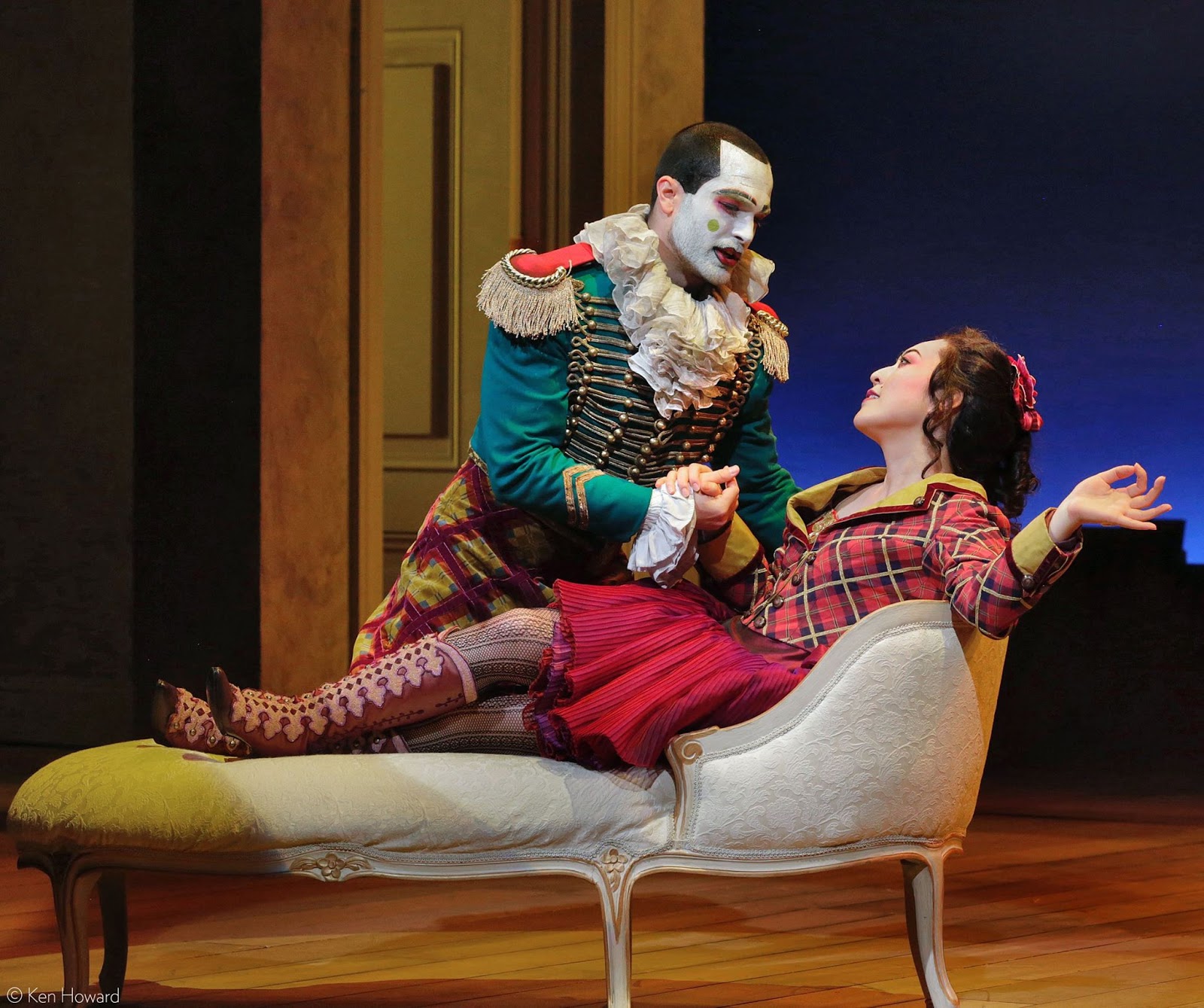

Ariadne auf Naxos is an opera that I have seen online several times, but never live and never in English before.  This infectious Richard Strauss opera works so much better live.  The antics of the commedia del’arte troupe along with the excessive hand-wringing from the traditionalists in the first act capped off by the lovely “combined” performance of the second act all worked together to make this a riveting and enjoyable experience.  And add to that the fact that it was performed in English.  Now, I am not usually in favor of performing opera in English, and prefer the original language.  In fact, I feel that often performing an Italian opera in English is like painting a mustache on the Mona Lisa, but in this case it worked great.  There is so much dialogue and there is so much going on that it would have been hard to follow in German. Plus the translation was pretty good and not groan-worthy. (wish I could say that for Boheme and Macbeth, which simply did/do NOT work in English - IMHO).  The final element of this great production was of course the cast and orchestra.  The orchestra for all of the operas is the St. Louis Symphony and their playing was exquisite throughout the season (especially in Shalimar!)  R. Strauss is not a walk in the park for the orchestra but they played the score brilliantly and the conductor infused much energy that kept everything moving at a nice pace.  The cast was across the board excellent (this is true for all 4 operas – not a weak link in the bunch!)  For Ariadne I felt the stand-outs were So Young Park as Zerbinetta, A.J. Gluekert as Bacchus and then the incredible Ken Page (otherwise known to theater-goers as Old Deuteronomy in the the original Cats production) as the Major-Domo. I had not realized that until later but while viewing was completely taken by his performance.  I doubt I will ever experience another opera performance where one of the standout stars was a non-singer in a non-singing role, but he was simply outstanding.  What a great idea to cast him, he BTW is a St. Louis native, so it was a kind of homecoming I suppose and he was warmly and enthusiastically received by the audience.  I doubt that Ariadne will ever replace Rosenkavalier as my favorite R. Strauss opera, but this was a terrific performance and a joyous way to begin the season.


La Boheme is perhaps one of the best loved opera of all times.  Many people who never go to the opera have nevertheless seen Boheme.  Among opera lovers it is interesting to me to read comments about this opera, for they tend to go from adoration to intense dislike with a strong dose of “I’m so tired of it.”  And I myself have sometimes found myself at times in the “tired of it” camp, until the downbeat and then I am engaged.  It is not only a beautiful score, but it is an incredibly well constructed score.  And for me the 2nd act is a perfect gem and perhaps one of the great accomplishments of late 19th century Verismo opera.  There is always a lot going on in the 2nd act and then it all is finished off with the onstage band marching across the stage.  And it is here I’ll begin my reflections about the OTSL production. There was simply too much on and off stage movement in this act which didn’t seem to have any purpose.  If it was to simulate the flow of the crowds on Christmas Eve in Paris it didn’t work for too often the chorus would leave the principals alone on the stage only to reappear just in time to sing and then disappear again.  That just didn’t work for me.  I wanted to crowds to be teeming throughout the act.  That said the ending was great.  I always love the band and this was no exception. The kids were great and the Parpignol (Eric Ferring) was easily one of the most memorable voices in the cast – what a beautiful voice and he only basically sang one note!  The cast were all young singers and were all very good.  I especially loved the Mimi of Hae Ji Chang and the Rodolpho of Andrew Haji and they had good chemistry.  She was especially effecting in the last act.  And the Shaunard of Sean Michael Plumb was another standout, what a beautiful voice.  Lastly, opera veteran Thomas Hammons sang the joint roles of Benoit/Alcindoro and he was terrific and then (on the Wednesday I attended) he turned around and took over the much more demanding and extensive role of Shalimar’s Father in the evening performance of Shalimar the Clown.  In closing I will say that I did enjoy this performance very much.  The singers all were very committed and sang beautifully.  I found myself wiping away tears on more than one occasion, including the ending of act 2 which always (for some reason) is an emotional experience for me.


Shalimar the Clown in another in the series of commissions and world premiere operas that OTSL has given to the opera world.  And this was for me a very moving and powerful experience.  The libretto is based on a novel by Salman Rushdie (he was at the performance I attended, which was cool!).  The story moves quickly around the world from LA to the small fictional village of Pachigam in Kashmir and back again to LA, this was effectively represented in a series of excellent projections.  The story deals with the issue of religious conflict and hatred and how it is that so many young men are radicalized and seemingly so quick to accept violence.  The opera begins at the end of the story – Shalimar (Sean Panikkar) has been stalking the former US Ambassador to India, Max Ophuls (Gregory Dahl), and has managed to get himself hired as Max’s driver.  After arriving at his daughter India’s (Andriana Chuchman) for a birthday celebration Shalimar murders Max.  And then we go back to the village and get to experience Shalimar’s long slow path from a sweet, shy Indian Muslim circus performer to a hardened, hateful and bitterly vengeful, and particularly violent murderer.  Early on we meet Boonyi (also played by Andriana Chuchman), the object of Shalimar’s affection.  But Boonyi is Hindu, so the first conflict is set up – a Muslim and Hindu who are forced to marry because they have been caught and blackmailed (or he tries to blackmail them) by a slimy schoolteacher (brilliantly portrayed by Geoffrey Agpalo).  The wedding itself is crashed by the Iron Mullah (Aubrey Allicock) who comes to condemn the pluralism represented in this bi-religion wedding.  But the community all join together to reject the hate and prejudice represented by the Iron Mullah and to reaffirm that they are all of one community and that they live in peace.  It is one of the most moving moments in the opera. 
But it cannot last, Max the Ambassador arrives and is smitten with lust by the young dancer Boonyi who runs off with him and is eventually impregnated by him.  His wife Peggy (Katherine Goeldner) keeps the child and sends Boonyi back to her village, but she has now been declared dead and finds herself an outcast.  Not only that but Shalimar is so filled with rage and that he has pledged to murder her and Max.  He joins the Islamic terrorist insurgency where he distinguishes himself as one of the most ruthless and bloody soldiers, even creeping out even the other terrorists because he is so blood-thirsty.  Eventually he makes good on his vow.  The village is destroyed by the Indian army and everyone is murdered – another incredibly powerful scene is the “Rape of Pachigam” the destruction of the village depicted by 6 dancers (3 men and 3 women) who act out a stylized by violent rape sequence.  It was hard to watch but impossible to turn away from – the music was particularly stunning here.  Boonyi manages to escape the Indian army but she meets up with Shalimar who is surveying the rubble of his home and taking note of the bodies of his parents and family and friends.  Shalimar murders her as he had vowed to do, even though I had the sense that he did it almost with regret. Regret that then fueled his determination to murder Max.  The ending of this opera is incredible.  The daughter of Max and Boonyi is a young Olympic archer named India (who knows nothing of her past or of the sordid story that brought her to life) but she finds herself facing off with Shalimar at the end, just as the lights go out.  I would like to read the ending of the book to find out how Rushdie ends this story. I am confident that India successfully defends herself, though it is left up in the air.
This was a powerful evening at the opera.  It is these kinds of experiences that keep me committed to this art form. Opera has a unique way of drawing the audience into the story through the music, and the music for this opera – composed by Jack Perla (libretto by Rajiv Joseph) – was wonderful.  I loved the score.  The orchestration included both a tabla and a sitar and utilized the winds in particular making the music both lush and stark as the story required.  I have heard that a recording will be released and I am looking forward to buying it and listening to it again.  The St. Louis symphony outdid themselves in performing this score.  The chorus of young apprentices who also took on a variety of small roles throughout the season also were especially terrific in Shalimar.  As for the leads, I said it above, this was a terrific cast from the two principals – Sean Panikkar as Shalimar and Andriana Chuchman as Boonyi/India.  Both roles require incredible acting chops and they both had it along with the vocal skills to perform the roles.  I would have to list the entire cast in order to list the excellent performances, but I have to at least point to Gregory Dahl, who was really outstanding as Max and managed to convey this complicated man.  It would be so easy to play him as a “bad guy” but I loved that Dahl’s Max was a very complex man, who is not bad, but not always good – who is self-giving and at the same time rather selfish – kind of like all of us.  And Katherine Goeldner was an effective Peggy who while the ignored wife still manages to accomplish perhaps the cruelest act in the entire story.  And Finally Aubrey Allicot as Bulbul Fakh, the Iron Mullah was terrifically and horrifyingly effective.

Lastly I want to say that the multicultural dimension of this work I found exciting and cutting edge.  We do live in a pluralistic world and we need to embrace and celebrate this.  We need to reject decisively those who would categorize and demonize other peoples and cultures and recognize that we are all in this together and we need each other. And the arts need to constantly model this and celebrate it.  This is a great step in that direction.  I truly hope to see many more productions of this wonderful opera around the country and the world.  It deserves it – but we need it!

I will post the final reflection on OTSL's Macbeth within the week.

Sunday, June 19, 2016

Sunday Night at the Opera - Don Carlos from Vienna

     I finally got to watch this wonderfully sung performance of one of my favorite operas from the Vienna State Opera.  Musically it was terrific.  The cast included Rene Pape, Ludovic Tezier, Ramon Vargas and Anja Harteros.  They were all terrific.  The performance was at times riveting and at times very moving.  But I have to say that the production is really pretty uninteresting.  In fact, it is the most uninteresting production I have seen of this opera.  The lighting is dark, dark, dark.  The set is non-existent. I suppose the production is traditional.  The costumes are a few hundred years later, but for the most part it doesn't seem to matter.  The best part is the singers and the singer's own characterizations and interactions.  Given the nature of this production it really is the only thing that saves this production - well that and the singing.  If the singers weren't so terrific this production would not be worth watching.  The chorus is adequate, the orchestra is pretty good, but the soloists in this performance were outstanding.

Wozzeck from Zurich: http://iopera.es/wozzeck-desde-zurich/
     I have been meaning to write a little about the Zurich "Wozzeck" I watched a few weeks ago. Years ago, when I was an undergraduate at New England Conservatory of Music I had the opportunity to perform this opera with Gunther Schuller conducting.  I played English Horn and it was a semi-staged production with a variety of singers - students and professionals.  I initially found the part hard as hell, but as I got to know it I came to really love the piece.  It is a brilliant opera and the music is genius.  This production from Zurich is very ingenious. The characters are like caricatures and it is as though they are all players in a carnival.  Which really works, the carnival being life itself.  One thing I found really effective was that all of the children in the last scene are costumed exactly like all the rest of the cast.  So the younger generation is a clone of the older and the cycle just repeats over and over again.  I felt that this production really captured the pessimism and futility that the piece conveys about life. I personally do not share Berg's pessimism and hopelessness about life.  But I understand it and this is a piece that needs to be experienced and taken seriously.  Many of the issues are universal, and the cycle continues and continues and continues. The cast - led by Christian Gehaher in the title role, were all excellent.  Gun-Brit Barkmin sang a compelling Marie; Brandon Jovanovitch was the creepy Drum Major and he was terrific I also really liked the Captain of Wolfgang Ablinger-Sperrhacke and the Doctor of Lars Woldt.  This is a terrific production and performance.

Saturday, June 18, 2016

Opera Platform - Verdi "Macbeth" from Latvia

     In an intermission interview Viesturs Meiksans, the director for this production of Verdi's "Macbeth" from Latvia made a comment that he felt that evil and good are a part of the human condition.  We are not pushed into evil by some outside force - like devils or witches - both evil and good are inside of us all. I don't disagree with this insight, but it does explain I suppose why this production puts the women of the witches chorus in the pit and they are invisible on stage.  Macbeth and Banquo just are conversing with the air.  It might have worked better if it were a personal conversation - just Macbeth and the Weird Sisters for example.  But since there are two of them it just didn't work for me at all.  True, both good and evil are a part of all of us, but for me this director missed the point of the Weird Sisters.  In the Shakespeare play the three witches are not evil, and neither are they good.  They do not push or inspire the action that follows.  They simply predict or anticipate the future.  Initially predicting that Macbeth will be made Thane of Cawdor this comes true immediately and it is Macbeth (inspired and pushed by his wife, Lady Macbeth) that takes it upon himself to enact the other predictions in a violent manner. The Weird Sisters are not evil, rather I think they represent fate and whatever they predict cannot be avoided, it will come to pass.  It is fate - Banquo will be the father of 7 kings, though not a king himself - Macbeth tries to change this and he cannot.  The director made one other comment which I think is completely wrong: In Shakespeare there are three witches and (according to him) Lady Macbeth makes the 4th. I am not sure I quite understand the significance of the number "4" in this case.  But I feel that this director really does not understand Shakespeare in general or this play in particular.  Lady Macbeth is a driving force, she pushes her husband to take fate into his own hands and to accomplish the predictions through violence.  For all of their colorful incantations the Weird Sisters never do anything of the sort.  They are rather a more colorful variation on the Norns, brew a caldron instead of weaving threads of fate. Lady Macbeth and her husband try and fail to master fate and in the process they destroy themselves and a nation.  Returning to the production then for me the least effective scenes were the ones with the Weird Sisters, in my opinion.  This includes not only the first scene but the famous scene with the apparitions, which despite the inclusion of the ballet (oddly choreographed, and what was up with the zombies - no Weird Sisters, but zombies instead - huh?  Didn't get this) these scenes simply fell flat.
     But, on the other hand, the remainder of the production was, in my view, rather effective and profoundly moving.  The murder of Macduff's family is not a part of the opera - though it is a horrific part of the play - usually we get the aria where Macduff has just found out about it and then sings of his reaction.  I find this beautiful aria is usually not up to the task of conveying the horror and grief of the revelation in general, depending on the actor the scene Shakespeare wrote is much more powerful.  Even so, this production included a silent depiction of this murder and it was harrowing and effective.  What followed was the incredible refugee chorus (performed magnificently by the outstanding Latvian Opera chorus) and then the aforementioned aria, which I thought was slightly more effective for having a fresh experience of seeing the murders on stage.  In the context of the horrible refugee crisis in our world today - a crisis that most Americans would prefer to ignore and no one really knows how to address - I found this scene to be extremely poignant and moving.  "Patria oppressa" indeed! In the way that England in the play comes to the aid of Malcolm, Macduff and the Scots it seems to me we in the wealthy west have a responsibility of these refugees, who we helped create.
     The murder of Banquo and his subsequent appearance was also quite effective.  The murder itself was kind of creepy and Macbeth's party breakdown was very well done.  It was effective that he spent most of the party scene trying to cover up the blood splatter from the murder with no success and that his lack of success is what prompts his meltdown.  This, of course, is one of the other major themes of the play - "what is done cannot be undone" - and the murder changes everything.  Nothing is the same.  I found the ending to be a bit disappointing - there was no fight, Macbeth just disappears.  The sleep walking scene was marred for me by the appearance of those 6 zombies.  The set and lighting were effective and I did like the projections and the way that the cast could appear out of the projections.  It provided some interesting context and was effective.
     The almost all Russian cast was really quite excellent.  Vladislav Sulimsky was an excellent Macbeth and Tatiana Melnychenko certainly has the voice of Lady Macbeth.  Her acting however leaves much to be desired. I also really liked the Banquo of Romans Polisadovs but found Sergey Polyakov's Macduff to be rather dull, his acting was similarly nonexistent. The supporting cast were good.  The star of this production however was the chorus without a doubt.  They were simply fantastic.  The orchestra was good, but they had their moments of shaky intonation and inaccuracy and ensemble problems.  The conducting of Martins Ozolins seemed adequate but that is the best I can say.
     This coming week I will be attending a live performance of Macbeth performed by Opera Theater of St. Louis.  After this experience it will be interesting to compare.

Friday, June 10, 2016

And Now… Some Shakespeare:

“Taming of the Shrew” in DC and “Tug of War: Foreign Fire” in Chicago

In between attending the Ring Cycle I had the opportunity to attend a performance of “Taming of the Shrew” in DC performed by the Shakespeare Theater Company. Now, I will confess that if I had had another Shakespearean option I would have skipped Taming and gladly attended another play.  For while I think the play is beautifully written, as all of the plays are, it is not a play I really like very much. Yes, I know it is a farce. Shakespeare is taking on an attitude about women, a male fantasy if you will, and making fun of it.  But in the 21st century it doesn’t really come across, even in this really excellent production.  The scene where Petruchio breaks Kate feels like abuse and the final scene, especially Kate’s final speech, is simply offensive.  “Let’s see which woman will obey” – yuck!
I have read some who argue that this was the attitude in Elizabethan England and we should just accept it on its own terms.  Except, it is not. Women did not willingly obey any more in Elizabethan England than at any other time, including our own.  True, it was a patriarchal society and women were forced into various roles, but at the same time there was a woman on the throne who was arguably the most powerful woman in the world at that time. No, the attitudes in the play represent male fantasy, not reality. 
The director of this production, Ed Sylvanus Iskandar, opening acknowledged the problem in his thoughtful program article. And one way he attempted to deal with it was that he determined that all the roles – male and female - would be played by men.  This, he suggested mitigated the distasteful elements of the play.  He also noted that there is a production currently playing in Central Park in New York that will use an all female cast.  He saw the two productions as a pair.  And I am sorry I cannot see the Central Park production as it would be interesting to compare. He also added some very interesting elements to further muddy the waters as it were.  But at the end of the day, the character’s genders have not changed.  The women are still supposed to be women, even if they are played by men. The violence of the breaking scene and the final scene are ultimately not mitigated by using male actors, at least not for me. Ultimately I came away from the performance slightly embarrassed that I had enjoyed it so much, for the play is really rather offensive.  I even mentioned this to a cast member in the lobby after the performance and he agreed with me.
So would I want to see the play not performed – no, absolutely not. I want to see this play done exactly the way this director did it.  With eyes open, and a desire to struggle with the difficult dimensions of the play.  For that I commend this director and the company for their work. I sensed no excuse making, but rather a clear and honest attempt to struggle with the rather difficult relationships in the play, and then to add even more difficult dimensions to them.
As the play is still running in DC I should say – SPOILER ALERT.  There was an openness to this production which I found unique and refreshing.  The cast mingled with the audience in the lobby and even performed songs before the play. During the intermission refreshments were served on stage and the audience was invited up on stage.  In a variety of ways the audience was invited to break the 4th wall and enter into the play.  And during some of these times there were subversive things going on, notably a little more than platonic relationship between Lucencio and Tranio, discovered by Bianca.  And one had the sense there was even more of this going on.  Another dimension I noticed was the relationship between the servants and masters.  In many ways these relationships were almost as abusive as the relationships between the men and the women.  What does that say about money and power?  And then adding in the subtext complications a completely different set of motivations and relationships begin to appear.  Remember that the entire plot is about money and property – it is not about love, or even about relationships or women – all of that is in service of the pursuit of money and property.  There is a subplot about lust – lust for Bianca – but ultimately the primary issue is who will become Baptista’s heir.
I want to complain about one director decision that I thought did not work. I understand that he wanted the establishment characters of Gremio, Hortensio and the wealthy Contessa to be somewhat representative of power bases in society and so Gremio becomes a Catholic Cardinal.  Except that Gremio is openly pursuing Bianca like the others.  He is just as lustful and desirous to marry her as all the others.  Ok, a Cardinal can be lustful, but to be openly a candidate for her hand in marriage just didn’t work.  He is a Cardinal, which means he is supposed to be celibate. Even in the Middle Ages high ranking churchmen worked harder to hide their assignations than this.  This didn’t work for me.  I don’t think having him being a churchman at all was necessary and added nothing. That is my only complaint.
The cast was excellent. The Kate of Maulik Pancholy was really terrific as was the Bianca of Oliver Thornton.  I had seen Telly Leung in Godspell on Broadway about 5 years ago and was really impressed and he was terrific as Lucencio also. Tom Story was outstanding as Hortensio, with equally outstanding work from Matthew Russell and Gregory Linington as the put upon servants Tranio and Grumio. Bernard White as the plotting father of the women Baptista was effective and I enjoyed the many incarnations of André De Shields.  Finally Peter Gadiot played the unsympathetic role (at least for me) of Petruchio and I can’t imagine it being performed more effectively.  The entire company was excellent.  This is a terrific production and performance.
Lastly, I have to mention that one of the unique elements of this production was the addition of original songs by Duncan Sheik. This added a unique dimension which I felt really worked.  At times it felt like a musical, the cast were all excellent singers and the songs were beautiful and effective.  In this way the music added yet another dimension of commentary and complication to the plot.  This was not a 2 dimensional “Taming;” all of these elements came together to create a complicated set of odd relationships.


Oliver Thornton as Bianca and Maulik Pancholy as Katherina

A few weeks later I travelled to Chicago to my 2nd favorite place on earth – Navy Pier – for 5+ hours of Shakespeare in the form of a montage entitled Tug of War: Foreign Fire.  Created by Barbara Gaines, director of Chicago Shakespeare, this long evening consisted of three plays: Edward III, Henry V and Henry VI, part 1.  These were cut to focus on the war-making dimensions and to fit into 5 to 6 hours of Shakespeare. The primary focus of this 1st part of Tug of War were the English wars against the French in an effort to win the rule of France during the Hundred Years War. In these wars there are the elites who make the decisions, often based on flimsy and questionable foundations, there are the commoners who are the ones who bear the primary burden of the fighting and the dying and there are the women who are also used as chess pieces in the complex back and forth between fighting and diplomacy. Edward III rescues the Countess of Salisbury from the Scottish only to attack her by attempting to coerce her into a sexual relationship. She resists (in one of the most wrenching and powerful scenes in the entire play – performed powerfully by Karen Aldrich as the Countess and Freddie Stevenson as Edward). Her success in shunning the King forces his response in commencing the brutal wars against the French that ends ultimately in the French defeat and deaths of 1000’s at Crecy and Poitiers. I had never seen Edward III before, and it is still somewhat contested.  I suppose this will be my only opportunity to see it, and I really loved the play.  It does bear some interesting parallels to Henry V.
Henry V is also cut to focus exclusively on war-making.  John Tufts’ Henry was not as sympathetic and likeable as most Henry’s. After a magnificent exposition of the Salic laws, delivered brilliantly by Steven Sutliffe as the Archbishop of Canterbury, Henry is engaged in the act of war on the French.  One of the most moving and poignant dimensions was having the Ghost of Edward III watching as events unfold and then repeating lines from the first play that perfectly parallel lines from Henry V during the Harfleur scene.  The brutality and cruelty is something the two Kings have in common. No nationalistic romp this production – the “Band of Brothers” speech was anything but inspiring.  Rather, yet another effort at manipulation coming as it does on the heels of the King’s rather self-serving wanderings through the camp where he argues his righteousness with his own soldiers.  Finally we have Princess Katherine used as a bargaining chip.  I felt that this scene was anything but cute and seductive, rather, it felt violent to me.  Katherine attacked to be taken as used, much like Petruchio’s Kate is taken and used.  But here it is in the service of a peace that will actually never take hold.
And the King dies young and is succeeded by his infant son and the entire French possessions are lost and in the process of regaining them we encounter a new woman, a warlike woman – Joan of Arc.  Played powerfully by Heidi Kettenring this is a woman who can stand up to men, who is as strong as any man and who has to be destroyed.  All the while a weak and pious Henry VI, played by Steven Sutliffe attempts to avoid conflict as his counselors are fighting bitterly with each other.  This play serves as a hinge from the French wars to the English turning in on themselves and beginning the civil war between the white and red roses – the houses of York and Lancaster (all descended, BTW, from Edward III).  This then sets up the next installment in the fall – Tug of War: Civil Strife which will include Henry VI, parts 2 and 3 and Richard III.
It is obvious that Gaines is making a statement about the stupidity and futility of war and violence.  She is also, not so subtly pointing out that while the men who make the decisions stand above the fray, on various levels of scaffolding looking down on the bloodshed and carnage, it is the poor foot soldiers who do the work of fighting and dying, by the 1000’s! (It is not an accident, I think, that both Edward III and Henry V, both include a lingering uncomfortable scene where they read a list of the killed and lost). It is also the women who are the chattel and are used and abused in this chess game of war, and who sometimes (like the Queen in an actual chess game) becomes a player herself (Margaret of Anjou, for example).  And for what, for a throne which is elusive and unstable (symbolized brilliantly by a golden tire hanging and lit in full view throughout the entire play.)  The final dimension is the music.  A rock band which plays and sings a series of songs about war and war-making serves as both participant and commentary on the action.
As is typical of the incredible work of Barbara Gaines there are so many little details that add so much to the performance.  My favorite: a young boy being given a hat to keep him warm by his mother as he leaves for the wars.  This cap continues to be featured in a variety of ways until it is finally returned to the mother, without the boy.  It was a moving symbol of the incredible cost of this kind of war-making.
I cannot even begin to pick out and name the incredible cast for this marathon venture.  As usual Gaines’ cast is tremendous, each and every one of them.  Larry Yando, Kevin Gudahl, Karen Aldrige, Heidi Kettenring, James Newcomb and Michael Aaron Lindner (who provided the only really effective comic relief of the adventure with his outstanding Fluellen) are all veterans of Chicago Shakespeare. New actors included Freddie Stevenson’s incredibly powerful and dangerous Edward III, John Tufts as his grandson the equally powerful and self-centered Henry V (no nice guy Hal, or even Falstaff to mitigate this character – there was a brief nod to this whole subplot when Henry momentarily reacted to the news that Pistol would be hung, but it was over in a moment.  After all those who break the rules must pay no matter who they are – that is if they are poor peasants!). And then there was Alex Weisman, whose youthful, almost childlike looks brought an incredible power to his scenes as Talbot’s son, and the boy with the cap.

I am really looking forward to the last installment in the fall.  This is an incredibly powerful work.  Hats off to Barbara Gaines.  The evening of the performance I attended there were cameras all over. I can only hope that they are recording this for television or some kind of release.  Shakespeare’s insights about war and war-making are just as relevant today as they were in his own time.  If only the war-makers would pay attention.
A video montage of Tug of War: Foreign Fire - Note the use of the paper crowns!

Monday, May 30, 2016

Sunday at the Opera - Rigoletto from Stuttgart - Opera Platform

Opera Platform's newest addition to their operas available for streaming is the Opera Stuttgart Rigoletto. I just finished it and first of all I want to say this is IMHO one of the best sung Rigoletto's I have heard in a long time. The young baritone Tito You is terrific as Rigoletto, but he is not alone the rest of the cast is excellent. Atalla Ayan sings a great Duke and Mirella Bunoica is a very tomboyish Gilda. Liang Li is wonderfully sonorous as Sparafucile and the biggest surprise of the performance is the outstanding Monterone of Roland Bracht. The Maddalena of Stine Marie Fischer was very well sung, but I found her characterization to be the most confusing of the production. What was her attitude towards the Duke? She didn't seem to like him at all, but yet she talks her brother into saving his life - why? The chorus was excellent and completely perverse and the entire performance was conducted by Guiliano Carella who paced a quick performance of this opera - in fact at times he almost left his singers in the dust, but they all managed to pull it off ok.  

The production by Jossi Wieler and Sergio Morabito is an interesting combination of traditional and Regie elements. Frankly, I'm not sure I completely understand the concept. But even so I enjoyed the performance very much. The production had me scratching my head at times but it never obscured the magnificent singing. There seemed to be an undercurrent of revolution which began with the Italian nationalist revolution (Viva Verdi! - how appropriate) and moved through the French Revolution and then ended up with the Chinese revolution under Mao (Rigoletto's costume in the last scene was a very wrinkled Mao costume). Gilda was played as much more independent and also with much resentment and anger towards her father - I actually really appreciated that, it was refreshing. I personally find Gilda's traditional naivité and victimhood to be rather tireseome. So she was more of a willing participant once she is abducted and seemed quite unhappy to be rescued. The problem with all of this is that the libretto consistently undermined the concept. In this case I almost wish I could have turned off the English titles. I would have enjoyed the production more. The end of the opera is really interesting. Made me think of Shakespeare: "All the world's a stage and the people in it merely players." Anyway, I really did enjoy this production and I hope to see and hear more of Tito You. He is a terrific dramatic baritone.

Thursday, May 26, 2016

Washington National Opera - The Ring of the Nieblungs - May 17 through May 22

How does greed and the lust for power impact our world?  We Americans are taught to aspire to success and wealth, which are only nice ways of saying power and greed.  And the result is an ecological crisis that has caused global warming and is endangering our entire planet.  But do we care?  Does it matter?  Do we care about those whose lives are affected by the destruction of our earth?  Do we care that development and economic success and “jobs” seem to be tied inextricably to the destruction of the planet.  I suppose if we replace all that green stuff – you know, trees and plants and grass and such – with impressive malls and high rises then that is progress!  but is it?
These are some of the questions posed by the Washington National Opera’s recent “American” Ring Cycle.  Taking a page out of the Patríce Chéreau playbook, Francesca Zambello set this Ring within industrialized America and creates a completely American cast of characters: Alberich begins as a prospector, Wotan the rich Tycoon, Fasolt and Fafner are working class construction bosses, Loge the fast talking political manipulator and so on.  But it seems to me that the “American” part of this was only a frame for the major focus which are the environmental issues.  We begin this Ring in the Rhine (“In it!” to quote Anna Russell) and it is a beautiful natural setting.  But the theft of the gold and the subsequent curse of the Ring – that is, the lust for power and wealth – slowly destroys (in one way or another) not only every single character in the 4 opera cycle but also ends up destroying the natural environment itself.  The settings in Götterdämmerung consisted of metal, and steel and “progress and development.”  But when we finally re-encounter the River Maidens in act 3 their habitat is now filled with trash and toxic waste and they themselves are dirty and wretched.  The journey of this Zambello Ring is a journey into the consequences of the exploitation of the environment for power, wealth and success.  How ironic it is that those who seek power the most are the ones who are first destroyed by their lust, their wealth turns to dust and their success ends with a spear in the back and an out of control toxic fire.
I have often heard Götterdämmerung described as Wagner’s “tale of the end of the world.”  Wrong!  This final opera is not about the end of the world, rather it is about the end of one age and the beginning of a new age.  Much like other great stories from the King Arthur stories to The Lord of the Rings the end of the Ring brings us a new beginning and a new hope.  While everything is in flames we hear Wagner’s incredible “redemption” motif which I believe we need to interpret without any religious baggage.  So, rather than use a religious term like "redemption" perhaps it would be more accurate to say that this motif is the motif of hope and new beginning.  The first time we hear it Sieglinde sings it in the middle of act 3 of Walküre.  She has lost everything, Siegmund is killed, she is on the run from Wotan and her protector, Brünnhilde, is not going to be able to help her any more.  She has nothing – except – she is pregnant and in that child lay the only strand of hope she can grasp on to.  And she sings this glorious motif before she leaves and heads east into the dark forest where she will be found by the wretched Niebelung Mime who is in his own sick way vigiling near to Fafner’s cave, in hopes of grasping the power and wealth of the Ring for himself.  But in that one moment we feel her hope and it courses through us as she sings.  And then at the end of the cycle we hear this motif again played in counterpoint to the magic fire music, for as the stage burns there is still hope.  And in this production Zambello has only the women on stage as a young girl emerges from the flames to bring forth and plant a tree.  It was a poignant and beautiful moment, and for me reflected the core inner meaning of the Ring Cycle.
Kip Cranna, the dramaturge for this WNO Ring made a very insightful comment in one of his many program articles: “The Ring is said to bestow unlimited power on its possessor.  But does it?”  He then lists all of the casualties and concludes: “Nearly all who possess the Ring, in fact fall victim to its curse.”  I think I sort of knew that, but had never really thought about it before.  But he is right.  And this should give us all pause as we continue to elect politicians who stubbornly (and stupidly) continue to deny the ecological catastrophe that we have created, and who connive with the barons of industry to gut rules and regulations that would protect our water, our parks, our environment and our air.  We will all end up like Fafner or Mime or Siegmund or Sieglinde or Hagen or Gunter or Gutrune or Wotan.  And do notice that the destruction of the Ring is not a respecter of persons, from the most unimportant and wretched to the great head of the gods.  So it is with us. 

It should be clear by now that for me this was not just a great Ring this was an epochal Ring.  I have seen many complete Rings, 4 live and many others on video or online.  All of them have had much to commend them.  The opening scene in Rheingold in the last Chicago Lyric production is still unsurpassed in my view; the projections in the LePage Ring; the Valkure scene from Schenk are all brilliant. But not since Chereau have I experienced a Ring that was so tightly constructed as this one.  Zambello built this adventure so that all the pieces fit together.  In many of the other Rings this is just not the case.  This WNO Ring has a focus and a direction that is unique and, I believe completely consistent with Wagner’s vision.  Musically this Ring was excellent, but so were many of the others, as good as the singers were (and we’ll get to that) this is not what makes this Ring stand out for me.  It is this relentless narrative that she never deviates from which makes this perhaps the most profound Ring I have ever experienced.
But now to the singers: The principals were in many ways among the finest performances of their roles that I have ever experienced.  Alan Held’s Wotan/Wanderer was perhaps the most human interpretation of this role I have seen.  He struggled, he got angry, he truly grieved, and he recognized his own limitations.  I have seen some other incredible Wotans who often play the role with a little more austerity, but Held’s performance joins the group of the finest Wotans and Wanderers who have taken on the roles.  And then there is Nina Stemme who was also incredible.  I loved how she transitioned from the bright Valkure to the wronged woman in the last opera.  Her vocal power and control during Götterdämmerung in particular was tremendous.  And then Daniel Brenna had not only a fresh, bright and powerful tenor as Siegfried but he had the youthful looks and he downplayed the spoiled teenager aspect of the role. He was certainly arrogant, but there was also a depth to his portrayal.  I have to say that Raymond Aceto was perhaps one of the finest Hunding’s I have ever experienced.  He had an aggressive and cruel streak which really made his character come alive.  He truly intimidated poor Siegmund, and Sieglinde was downright terrified and you could see why.  Not only that but his dark, full bass gave this Hunding a really scarey dimension.  Eric Halverson was an appropriately menacing Hagen with a rich and beautiful bass; Gordon Hawkins an effective and well sung Alberich.  And one of my favorite artists – David Cangelosi – gave us a fully realized Mime, terrifically sung and acted.  I had seen him do this role in Chicago, but that was 10 years ago and in the intervening 10 years his interpretation has deepened.
The remaining cast was also excellent all around, from the smaller supporting roles to larger roles the casting was excellent.  Among the stand outs for me: William Burden who was an appropraitely slimy and manipulative Loge; Elizabeth Bishop as Fricka (especially in Walkure); Julian Close as Fasolt and Soloman Howard as Fafner; Lindsay Ammann as Erda, Schwertleide and the First Norn; Meagan Miller as Sieglinde, Christopher Ventris as Siegmund; Melissa Citro as Gutrune; Ryan McKinny as Gunther.  And such luxury casting to have Jamie Barton as the 2nd Norn and Waltraute – she was wonderful!  In fact the Norn scene was one of my favorite scenes in this production.  The Trio was rounded out with Marcy Stonikas as the 3rd Norn.
I have to mention that the conductor Philippe Auguin conducted a well paced score and the orchestra responded, for the most part to his leadership.  The Ring is long, and it is hard for everyone but this performance was not without its difficult moments from the orchestra, particularly the winds.  Intonation seemed to be a struggle consistently throughout the Ring, but it was especially noticeable in the chords at the beginning of the Brünnhilde awakening scene.  There were missed notes in the brass from time to time, but in general the brass were very good; a special bravo to principal horn Geoffrey Pilkington and to principal tubist Michael Bunn.  The tuba solos in Siegfried in particular were exceptionally well played, beautifully shaped, with much color and dynamic range.  I am not sure who played the off stage horn solo in Siegfried, but it was well done.  I should say that the strings were terrific throughout.  Whatever problems there were in the winds and brasses did not seem to extend to the strings who shone wonderfully throughout.  I have to say I found it odd that there seemed to be a fair amount of coming and going in and out of the pit.  And it wasn’t just players who were going backstage.  Also, I personally feel (after 30 years as a professional orchestral musician myself) that practicing excerpts during the break and doing crosswords or reading in the clear view of the audience during the performance is completely unprofessional.  And yes, this happened, but I won’t name names.
Lastly, I have to say that in all the Rings I have seen one of the things that interests me is to see how the dragon will be depicted.  Spreight Jenkins said in an interview once that the dragon was one thing that he often got complaints about.  In too many Ring productions the dragon is a major disappointment.  I suppose that in these days of CGI and “The Hobbit’s” Smaug it is hard to produce anything quite that convincing on stage.  But of all the dragons I have experienced I loved this WNO dragon.  It was done in a way that was in keeping with the vision of the production and it was very effective. 


Finally, I am so glad to have had the chance to attend this Ring. It was an experience and an adventure of a lifetime for me.  Certainly this is one of the most thought-provoking and consistent productions I have ever seen.  I hope that this production continues to have a life beyond this presentation.